The third and final instalment of our tour of Britain's most awkward place names reveals that while they sound like teenage jokes, their origins are often surprisingly boring—and very old. After exploring the Snorings, Ham Sandwich in Kent, and Lost in Scotland, we now tackle the 'Bottoms', 'Ends', and 'Knobs' that make modern GPS systems blush.
The Bottoms and Thongs
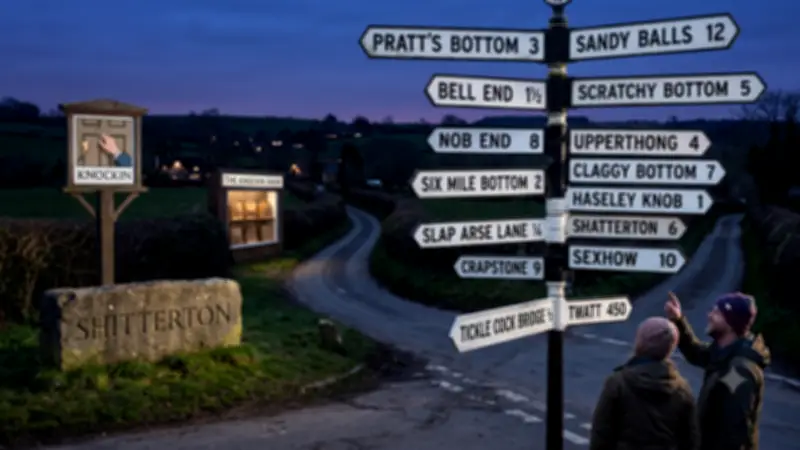
In geographical terms, a 'Bottom' is simply the lowest part of a valley. But try explaining that to a delivery driver looking for Pratt's Bottom in Kent. This well-to-do area remains the undisputed heavyweight champion of awkward addresses. One reader told us of 6 Mile Bottom in Cambridgeshire; they used to joke it was where their mum came from, as she always complained her hips were too big.
Claggy Bottom in Hertfordshire sounds sticky, while Kettlesing Bottom has Norse origins, derived from Ketels-eng meaning 'Ketel's meadow', and the 'slack' of Slack Bottom refers to a hollow in the hillside. Lynsore Bottom in Kent sounds painful but is a delightful village surrounded by countryside. Bullyhole Bottom in Gwent reflects the practical, agricultural nature of the area. Scratchy Bottom, a cliff-bound valley in Dorset, likely suits the local sheep even if the name suggests otherwise. Happy Bottom, also in Dorset, offers a more cheerful alternative.

Upperthong and Netherthong in the Holme Valley derive from 'thwang', a narrow strip of land, nothing to do with Victorian swimwear. Sandy Balls in the New Forest, a renowned holiday village dating back to the 15th century, was originally named Sandyballas under Henry VII, referring to dome-shaped sand and gravel outcrops.
The Ends
In medieval England, an 'End' was simply the edge of a parish or small settlement. Bell End in Worcestershire frequently tops 'rudest street' lists; residents have campaigned both for and against the name, but the 'Bell' (likely from a local church tower) remains at the 'End'. Nob End in Bolton was a waste heap from the 19th-century chemical industry but is now a beautiful Site of Special Scientific Interest. Lickey End, just down the road from Bell End, kept local sign-makers busy.
One reader flagged a route near Warwick: Haseley Knob and Mousley End. As they suggested, travelling between the two might warrant antibiotics. In reality, a 'Knob' is an Old English term for a rounded hill—a perfectly respectable geological feature, unless read on a road sign at 60mph. Knob Hall Lane in Southport has been plagued with potholes for years, apparently.
The Best of the Rest
Sexhow in North Yorkshire sounds like a specific question but comes from Old Norse for 'Sekks-hill'. Slap Arse Lane in Mellor was likely named after a local farmer or a corruption of an old mining term. Shatton near Hathersage is often paired with Brough by tourists. Crapstone in Devon is a lovely spot near Plymouth despite the muddy-sounding name. Cockadilly in Gloucestershire sounds like a cross between a bird and a city street, and Cockle Dicks Lane in Southport has survived every attempt to modernise it. Upper & Lower Dicker in Sussex: a 'Dicker' was an old trade term for a bundle of 10 hides. Wetwang in Yorkshire was once home to weather legend Ian McCaskill, who served as honorary mayor.
Famous Places That Took Drastic Measures
Shitterton in Dorset became so tired of tourists stealing their wooden sign that residents chipped in for a 1.5-ton stone replacement, making it theft-proof unless you own a heavy-duty crane. The stream it sits on flows into the River Piddle. Twatt in Orkney derives from Old Norse 'pveit' (a small parcel of land), predating the modern insult by centuries. Tickle Cock Bridge in Castleford: in 2008, the council tried to rename it Tinkler's Bridge to be more polite, but locals successfully campaigned to reinstate the original name. Knockin in Shropshire: the village shop has leaned into the joke for years, reportedly doing a roaring trade in branded paper bags for visitors.

As Jayne Middlebrook, Head of Product and Engagement at InYourArea, concludes: 'Looking back over these three rounds, it’s clear that the UK isn't just a place of high tea and historic castles; it’s a living, breathing comedy of errors. Our ancestors were practical people. If there was a mucky lane near the town hall, they called it Mucky Lane. If a valley was owned by the Pratt family, it was Pratt’s Bottom.' She adds: 'A huge thank you to everyone who wrote in with their local gems. Whether you live in No Place, Lover, or Great Snoring, you are part of a wonderful, whimsical tradition that keeps the British map the most entertaining read in the world. Oh, and please drive slowly through OLD in Northamptonshire—and try not to laugh too hard at the signposts!'