Engineer Creates Functional Electric Car Battery from Discarded Vapes
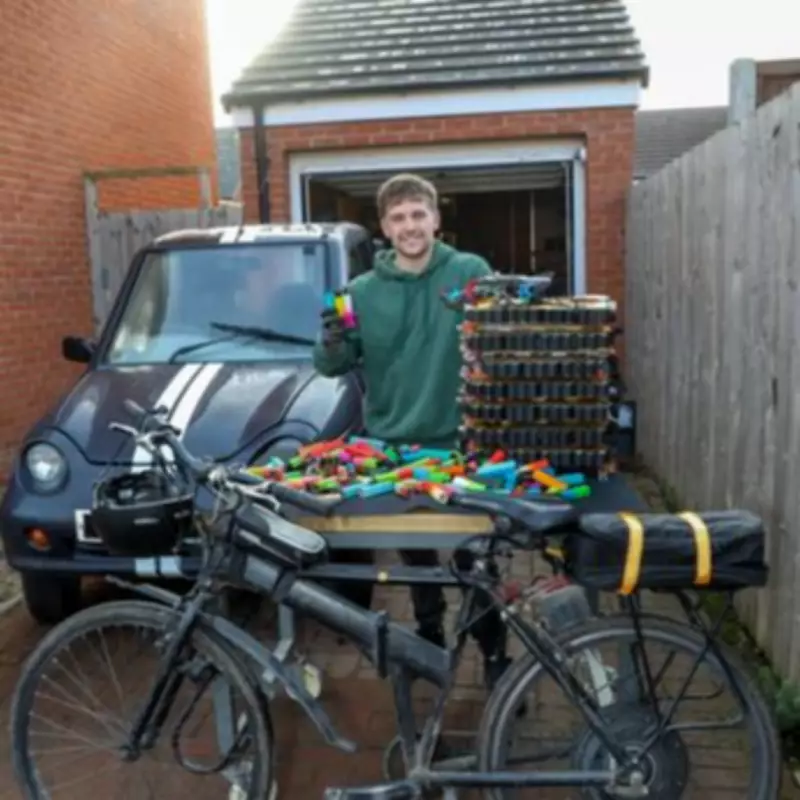
An innovative engineer has successfully powered an electric vehicle using a homemade battery pack constructed entirely from discarded disposable vapes. Chris Doel, a 27-year-old from Rugby, Warwickshire, dismantled 500 vapes to extract their lithium batteries and create a substantial power source capable of running both his home and an electric car.
Raising Awareness Through Practical Innovation
Chris undertook this ambitious project primarily to highlight the environmental impact of disposable vapes, which he describes as "crazy devices that just absolutely shouldn't exist." He explained that disposable vapes represent the most extreme example of planned obsolescence, where manufacturers create products with intentionally limited lifespans to encourage repeated purchases.
"The problem goes even wider than disposable vapes," Chris noted. "When it comes to the concept of planned obsolescence in general, where manufacturers make devices they know will die sooner than the end of the actual lifespan of the parts, just so you have to buy another one. Unfortunately, it's becoming more and more common."

The Technical Challenge
In May 2025, Chris visited his local vape shop and collected approximately 2,000 returned disposable vapes. The extraction process alone took six months, as he carefully removed the rechargeable lithium batteries from each device. Using a 3D-printed casing, he wired 500 cells in parallel groups connected in series to create a substantial battery pack.
Initially, Chris used this battery to power his home for eight hours, proving the concept worked. He then turned his attention to a more ambitious goal: powering an electric vehicle. The main challenge was finding a car with sufficiently low power requirements to make the project feasible with his vape battery pack.
The Perfect Vehicle Choice
After consulting with colleagues, Chris identified the 2007 G-Wiz micro-car as the ideal candidate. This vehicle, once labeled the "Worst Car of the Year" by Top Gear, features a modest 48-volt battery system compared to modern electric vehicles like Teslas that typically use 400-volt systems.
"I was speaking with a colleague about how I wanted to power a vehicle with the battery, but because EVs have such enormous batteries, I thought it was never going to be possible," Chris recalled. "My colleague came up with the genius idea of using the G-Wiz. It's pretty much the only car out there with a 48v battery – so it meant the power-wall would work with it."
Five Months of Intensive Work
Chris purchased a second-hand 2007 G-Wiz for £800 from a dealer north of London. The vehicle came without a working battery, making it perfect for his experiment. Over the next five months, he dedicated five hours each weekday evening and twelve hours daily on weekends to rewiring the vehicle and completing necessary legal documentation.
He completely stripped and refurbished the car's electrical system, creating a secure enclosure for the vape battery pack. "I made a big enclosure – worst-case scenario, if it were to go up in flames, I would want it to be at least somewhat contained and not be rattling all over the place," he explained.
Legal and Insurance Challenges
Ensuring the vehicle was road-legal presented unique challenges. Chris obtained an MOT certificate and secured £600 annual business insurance, though explaining his unconventional battery setup to insurance providers proved difficult.
"The person on the phone didn't really have a clue what I was going on about," Chris said. "As I was explaining the full setup and trying to explain I was doing a battery swap, they said, 'We don't really have a lot of options for the mods you are listing online.' It cost a decent amount of money, but given the fact they're taking the risk of it being a battery pack literally made of vape cells, it was incredibly cheap in the grand scheme of things."
Successful Test Drive and Current Status
After five months of work, Chris finally took his vape-powered G-Wiz for a test drive last month. The vehicle operated for two hours, covering 18 miles entirely on power from the salvaged vape batteries before depleting its charge.

Chris has since removed the vape battery pack from the vehicle and replaced it with two Tesla battery modules, which he now uses for his daily transportation. The Tesla modules operate with custom software that tricks them into believing they're installed in a Tesla Model 3.
Throughout the project, Chris documented his progress on his YouTube channel, sharing both the technical details and his environmental message about the wastefulness of disposable electronic products.