The Sweet Pea Sowing Season: Your Guide to Fragrant Climbers
Sweet peas are remarkably easy-to-grow annual climbers that offer both visual beauty and an enchanting fragrance. Now is the ideal moment to begin sowing these delightful plants. Within approximately 12 weeks, you can expect to see their delicate tendrils and pastel-coloured blooms gracefully scrambling over trellises, bamboo wigwams, or netting structures in your garden.
Beyond their role in softening garden boundaries, sweet peas are exceptionally well-suited for displaying in vases. Each individual flower resembles a resting butterfly, perched not directly against the vine but on a stiff, elegant stalk that holds three to five flowers away from the grey-green foliage. Their powdery, sweet scent is another major attraction, often drifting on the breeze and through open windows during warm summer evenings.
A Rich Historical Legacy
Our enduring affection for sweet peas traces back to the early 20th century, a period marked by what was known as 'sweet pea mania.' The fragrance was so highly prized that these flowers became the most popular choice for buttonholes among Edwardian gentlemen. In 1911, when the Daily Mail offered a £1,000 prize—equivalent to roughly £100,000 today—for the best bunch of sweet peas, the response was overwhelming.

More than 38,000 bunches were sent to London by train from across the United Kingdom. The sheer volume necessitated using the Royal Albert Hall to display them all. This event remains one of the largest horticultural competitions in British history. The turn of the century represented a boom time for sweet pea breeders, who developed the two primary types we cultivate today.
Key Varieties and Their Characteristics
Spencer Varieties: These are the most common type, featuring huge, ruffled blooms and long stems, making them ideal for vase arrangements.
Grandiflora Varieties: These have smaller flowers but emit a much more powerful scent. If you desire a fragrance that can be detected from across the garden, these are the ones to choose.
Notable cultivars include 'High Scent' (Spencer), a modern breed with creamy white petals edged in delicate violet-blue, known for its long, sturdy stems. 'April in Paris' (Spencer) offers soft cream blooms with a lilac flush and a strong, clean scent, boasting a high flower-to-leaf ratio. Among Grandiflora types, 'Matucana' is an old-fashioned bi-colour favourite in deep maroon and violet, widely regarded as the most fragrant and incredibly tough. 'Cupani' (Grandiflora) is similar but with smaller flowers and an intense, sweet, and spicy scent, noted for its heat tolerance.
Essential Growing Tips for Success
Scent Maximisation: The optimal times to enjoy the fragrance of sweet peas are early morning or late evening. Midday sun can sometimes 'cook' the volatile oils, causing the scent to fade until the air cools again.
Training Assistance: While sweet peas are agile climbers, they occasionally need a little help getting started. Use a small piece of garden twine to loosely tie the first few centimetres of the stem to your trellis. Once they find the mesh, they will take over and can grow up to 2 metres high.
Pinching for Bushiness: Pinching is the secret to cultivating a bushy plant with abundant flowers. When the plant reaches about 10 to 15 centimetres in height, locate the main growing tip and pinch it off with your fingernails. This encourages the plant to send out two or three side shoots instead of producing just one lanky stem.
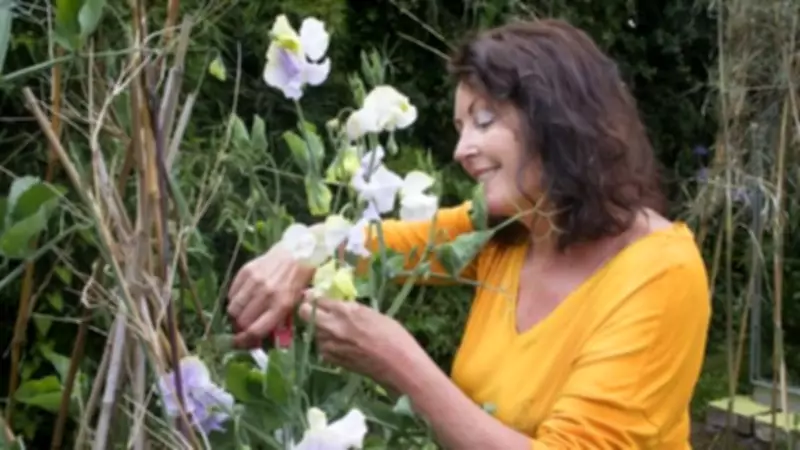
Picking for Prolonged Bloom: Once flowers appear, the golden rule is to pick, pick, pick. As soon as a flower fades and begins forming a pea pod, the plant may think its job is complete and cease flowering. To maintain blooms throughout the summer, cut flowers every two to three days. Even if you do not wish to bring them indoors, it is crucial to deadhead spent flowers before they develop into pods.
Important Safety Note
With all this discussion of pea pods, it is vital to mention that ornamental sweet peas (Lathyrus odoratus) are toxic. Never plant them so close to edible garden peas (Pisum sativum) that their pods could be confused during harvest time, ensuring safety in your gardening practices.