The political map of Birmingham has undergone a dramatic transformation following the 2026 local elections, with the city now a patchwork of different parties and personalities. All victors have been declared, and it is clear that Birmingham's politics have entered unprecedented territory.
Rejection of Two-Party System
Last Friday, voters rejected the two-party system, and Labour lost control of the city council amid widespread frustration among residents. Birmingham's politics now resemble a colourful patchwork, with Reform UK and the Greens overtaking traditional parties such as Labour and the Conservatives.
Coalition Talks Underway
Talks are now taking place between various groups and individuals to see if a coalition can be formed to find a way forward for both the council and the city. This political fragmentation is a stark contrast to just four years ago, when Labour won a majority with 65 out of 101 seats on the council.

2022 Election Map
A map representing the 2022 election results shows Labour winning huge swathes of central and inner-city Birmingham, as well as seats in southern communities such as Stirchley, Moseley, Brandwood and Kings Heath, Northfield, and Allens Cross. The Conservatives were the second largest party, performing well in the north around Sutton Coldfield and in the south in places like Longbridge and Rubery & Rednal. The Liberal Democrats gained 12 seats, achieving success in areas such as Yardley in east Birmingham, while the Greens had just two councillors in Druids Heath and King's Norton South.
2026 Election Map
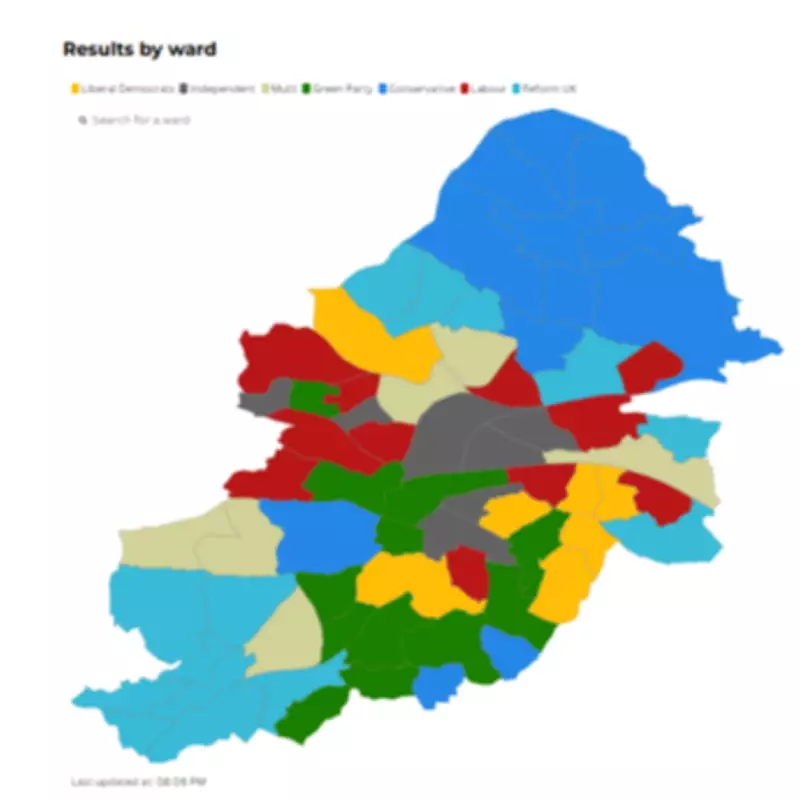
The 2026 map looks very different. The sea of Labour red has been fractured, with voters in and around central Birmingham backing independents and the Greens. Labour's southern seats have largely been lost, with the Green Party capitalizing on resident exasperation and gaining seats in Stirchley, Brandwood & Kings Heath, Bournbrook & Selly Park, and more. The Greens also won over voters in inner-city areas such as Handsworth and Ladywood, increasing their councillor count from two to 19.
Labour managed to hold onto seats in Gravelly Hill, Heartlands, Handsworth Wood, North Edgbaston, and Soho & Jewellery Quarter but ended up with just 17 councillors—a loss of 48 compared to 2022. Reform became the biggest party on the council, partly by venturing into territory in the south-west of the city that previously belonged to either the Conservatives or Labour. Their block of seats to the south includes Northfield, Longbridge & West Heath, King's Norton North, Weoley & Selly Oak, Allens Cross, Rubery & Rednal, and Bartley Green. The new party also gained seats in the north, such as Kingstanding, Oscott, and Perry Common.
The number of Tory councillors dropped slightly, but they maintained their stronghold in the Sutton Coldfield wards and Erdington. The Liberal Democrats remained steady at 12 councillors, with voters showing loyalty in Yardley, Moseley, and Perry Barr. In Glebe Farm and Tile Cross, the Workers Party gained their first councillor.
Political Makeup of the Council
With no party having even half the numbers needed for a majority (51 seats), attention now turns to whether a coalition can be formed in the coming days. The new political makeup is as follows: Reform UK – 23, Green Party – 19, Labour – 17, Conservative – 16, Independents – 13, Liberal Democrats – 12, Workers Party – 1. Both the Conservatives and Liberal Democrats have already set out their positions, while Councillor Jex Parkin, leader of the Reform group in Birmingham, stated that his party is "unable to form an administration."