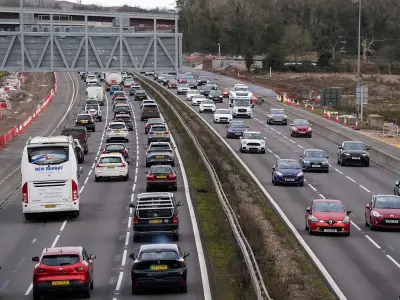
Electric vehicle owners in Britain will be charged for miles driven overseas under a major new tax policy confirmed by the Labour government.
What is the new eVED charge?
Labour MP Dan Tomlinson has confirmed that the upcoming Electric Vehicle Excise Duty (eVED) will apply to all mileage, including journeys made outside the United Kingdom. The new system, announced at Budget 2025, is scheduled to start in April 2028.
It introduces a mileage-based charge for electric and plug-in hybrid cars, addressing the government's view that these vehicles contribute to road congestion and wear but currently pay no equivalent to traditional fuel duty.

Why will overseas travel be included?
In a written response to a query from Conservative MP Nick Timothy, Mr Tomlinson explained the rationale. He stated that the government has ruled out using location or time-based tracking for the tax to protect motorists' privacy.
This decision means the system cannot differentiate between domestic and foreign travel. Consequently, non-UK mileage driven by UK-registered cars will fall within the scope of eVED, mirroring the existing principle for fuel duty, which also does not vary based on where a car is driven.
"The vast majority of eVED will be paid on travel in the UK," Tomlinson noted, citing an estimated 225 billion car miles in Great Britain in 2024.
Financial impact and how it will work
The charge is expected to be set at around 3p per mile. With battery electric cars averaging about 8,900 miles annually in 2024 according to DfT figures, this could mean an extra £267 per car each year.
Applied to the 1.4 million EVs currently on UK roads, the policy could generate approximately £375 million annually for the Treasury.
From 2028, EV drivers will likely pay this mileage supplement on top of their standard annual road tax (VED). The distance used for the calculation could be a self-declared estimate or verified via an odometer check during an MOT test.
Mr Tomlinson emphasised that taxation of motoring is a critical source of funding for public services and infrastructure investment, justifying the move to ensure all road users contribute fairly.