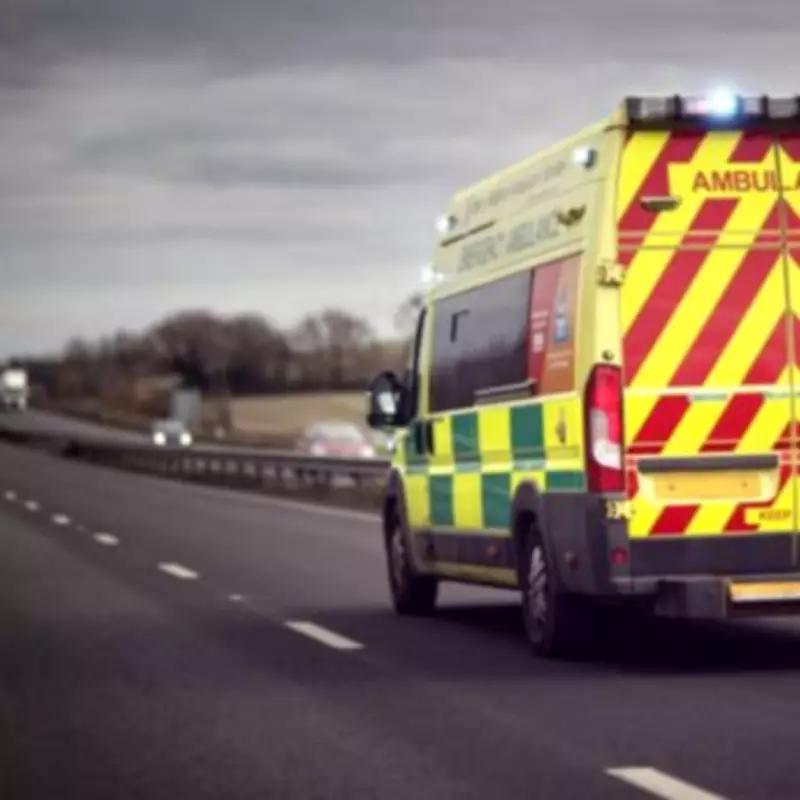
Drivers have been warned that letting ambulances past could lead to fines of up to £1,000 if they break traffic laws in the process. While most motorists know they should give way to emergency vehicles with flashing blue lights, the situation is not always straightforward.
Common mistakes and penalties
Motorists must take care not to violate traffic regulations, such as driving in a bus lane or disregarding a red light, as this could result in substantial penalties. The same caution applies when considering entering a yellow box junction. Beyond monetary consequences, particular violations, like jumping a red light, can also result in three penalty points being endorsed on your licence.
RAC advice
The RAC stated: "When being caught up by an emergency vehicle, most drivers will follow their instinct to get out of the way as fast as possible. But if you're not careful, your best intentions could still see you hit with a hefty fine. This is because road laws still apply in the event of encountering an emergency vehicle and you will still need to comply with relevant UK road signs."

The RAC added: "So the key is not to panic and always stay alert when driving. Resist temptation to stop in the middle of the road – this could block the route for the emergency vehicle – or to jump up the kerb. Keep driving until there's a suitable place to pull over and use your common sense to avoid coming into conflict with other road users."
Ambulance service guidance
A representative from West Midlands Ambulance Service explained: "If you are at the lights and can see an emergency vehicle behind you, stay where you are until the light turns green or the emergency vehicle has passed. Our teams are trained to safely navigate through traffic, sometimes using oncoming lanes or filter lanes. But when it is not safe, we will maintain a safe distance, turn off sirens but keep lights on, and wait until it is safe to move."
Highway Code rule 219
Rule 219 of the Highway Code says: "You should look and listen for ambulances, fire engines, police, doctors or other emergency vehicles using flashing blue, red or green lights and sirens or flashing headlights, or Highways Agency Traffic Officer and Incident Support vehicles using flashing amber lights. When one approaches do not panic. Consider the route of such a vehicle and take appropriate action to let it pass, while complying with all traffic signs. If necessary, pull to the side of the road and stop, but try to avoid stopping before the brow of a hill, a bend or narrow section of road. Do not endanger yourself, other road users or pedestrians and avoid mounting the kerb. Do not brake harshly on approach to a junction or roundabout, as a following vehicle may not have the same view as you."
Blue Light Aware clarification
The Blue Light Aware website clarifies: "Of course, there will be times when there simply is no room for an emergency service vehicle to get past, or perhaps its crew are activated by their control room to respond to an emergency while they are waiting with everyone else at the traffic lights. On these occasions, they know that other motorists are not allowed to 'jump' the red light, and the emergency vehicle would ideally not activate its sirens and lights until it was safe for the vehicle in front to cross the solid white line at the junction. On the (hopefully) rare occasions that a blue light vehicle, in 'emergency mode', is sitting behind another vehicle at a red traffic light, it's important to appreciate that it would be both very dangerous and illegal for the other vehicle to move across the solid white line."
What does it mean when an ambulance is silent with lights on?
The RAC says that when an ambulance is using its lights but not its siren, it typically indicates that the emergency vehicle is responding to a situation where it needs to be visible to other drivers for safety reasons, but the noise of the siren isn't necessary at that moment. This might occur in a variety of scenarios, such as when the ambulance is traveling through a quiet area or when it's arriving at a scene where the noise might be disruptive. Scenarios include late at night, when they are already at the scene of the incident, or if there are cyclists, horse riders or other road users in potentially vulnerable positions.