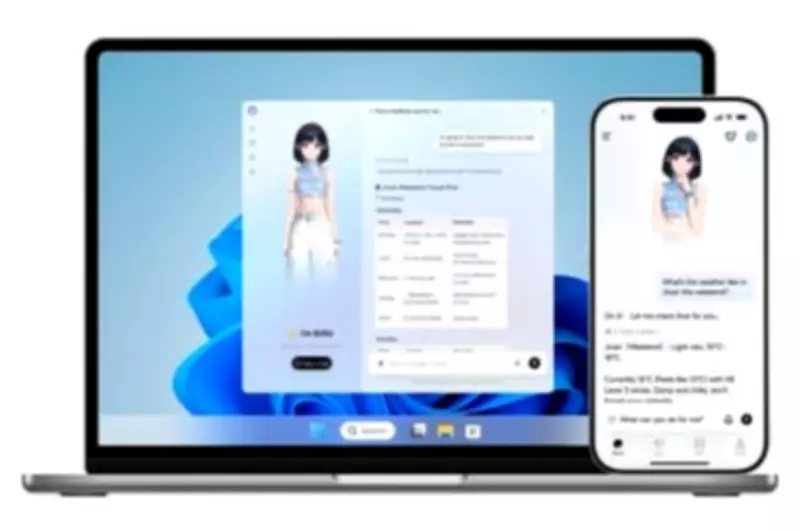
SentiPulse has introduced SentiCat, an agent-based system positioned as an early step toward its broader digital human system. As artificial intelligence evolves from conversational models to action-capable agents, a longer-term trajectory is beginning to take shape: AI is moving from on-demand tools toward systems designed for sustained interaction.
When launched on desktop, users encounter more than a chat interface—they are greeted by SUSU, a 3D AI persona with a persistent identity and personality, designed to support ongoing, context-aware interaction over time.
Agents as a Stepping Stone
"We do not view agents as the end state—they are a step along the path toward digital humans," said Grant Han, CEO of SentiPulse. "Agents provide the ability to execute tasks and take action, serving as the operational layer that enables digital humans to perform work. At the same time, we are developing capabilities for emotional awareness and expression in digital human systems."

In practical use, users no longer interact with a passive tool that waits for instructions. Instead, they engage with an always-available system designed for ongoing interaction over time. During conversations, the system can invoke underlying agent capabilities to execute multi-step tasks, including retrieving information, processing files, and completing automated workflows within a single interaction.
Shift from Single-Session to Persistent Engagement
This design reflects a shift in the user-system relationship from single-session interactions to persistent engagement. According to SentiPulse, this transition affects not only user experience but also system performance. "If users only engage the system when a task arises, it becomes difficult for an agent to build meaningful context," said Grant Han. "The duration of interaction directly shapes execution quality."
From a technical standpoint, SentiPulse positions the AI persona as the interaction and presence layer, responsible for user-facing engagement and continuity, while agents provide the underlying execution and behavioural capabilities. Together, they enable the system to complete tasks while incrementally building a more detailed understanding of the user over time. In SentiPulse's framework, AI personas are early forms of digital humans, unifying personality, memory, and action.
Competition Shift and the Flywheel Effect
In the agent space, as execution capabilities become more standardised, competition is shifting from "what the system can do" to "whether it is used continuously over time." SentiPulse frames this as a flywheel: longer engagement leads to richer context, improved system understanding, increased efficiency, stronger user reliance, and continued usage.
Grant Han noted that this approach is becoming viable due to the parallel maturation of several technologies, including large-scale models, long-term memory systems, and agent frameworks. SentiPulse has also built a foundation in the 3D digital human domain, with capabilities spanning character design, motion generation frameworks, interaction datasets, and dialogue decision models.
The Future Role of Agents
Within this context, the role of agents is also evolving. Rather than functioning as standalone applications, they are increasingly positioned as a foundational capability layer supporting more complex interactive systems. For SentiPulse, however, this layer is not the final destination. The ultimate goal is a digital human system capable of sustained interaction with users in a continuous operating context.