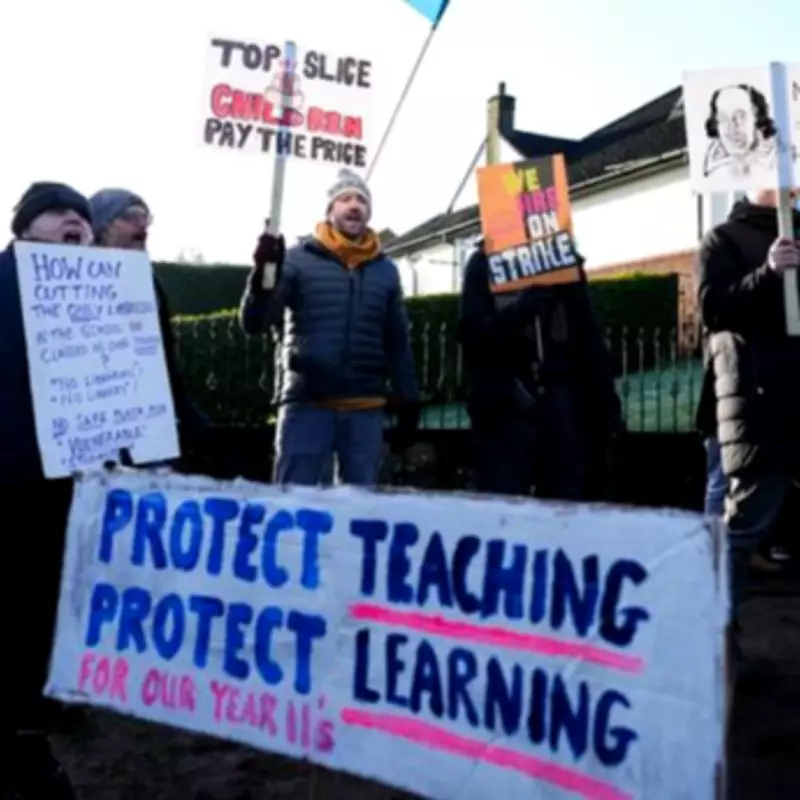
Strikes have concluded at the Arthur Terry Learning Partnership following a recent agreement, yet significant concerns persist regarding the multi-academy trust's financial stability and future direction. The resolution means approximately 11,000 children across Birmingham and the Midlands will return to full-time education next week, ending a month of disruption across 20 schools.
Financial Black Hole and Mounting Debt
The trust, which operates 24 schools across the West Midlands including in Sutton Coldfield, Birmingham, Coleshill, Lichfield, Tamworth, Coventry and Warwickshire, finds itself grappling with substantial financial challenges. According to its latest accounts, the organisation is burdened with debt approaching £10 million, having secured millions in repayable loans from the Department for Education.
While all current restructuring and redundancy consultations have been temporarily halted through a joint statement with the National Education Union, the underlying financial pressures remain acute. The NEU had previously indicated that around 100 positions were at risk before the pause was implemented.

Parental Concerns and Trust Responses
During the industrial action, frustrated parents raised numerous questions about expenditure priorities, prompting the trust to issue a comprehensive frequently asked questions document. Key areas of concern included the provision of iPads to every pupil, staff development trips overseas, and substantial payments to senior management.
The iPad Programme Controversy
Parents specifically questioned why all 11,281 pupils received Apple tablets amid financial difficulties. The trust clarified that this one-to-one device programme was funded from reserves based on earlier financial forecasts, and that the tablets were leased rather than purchased outright. They argued the initiative has generated savings through reduced printing and paper usage, while acknowledging that all expenditure areas are under review for potential cost reductions.
Overseas Staff Trips Examined
The trust confirmed that two staff members participated in a California trip organised by Apple for leadership development, while two additional visits to Dubai occurred in 2024. Importantly, they emphasised that the Dubai trips were fully funded by external companies - Scriver, a hardware firm, and JTRS, an Apple-authorised education specialist - with no cost to the trust itself. All overseas visits received formal board approval.
Executive Remuneration Clarified
Addressing concerns about substantial payments to senior staff, the trust corrected earlier reports that four individuals received £1.85 million. They clarified this figure actually represents compensation for eight senior leaders, whose salaries are independently benchmarked against comparable organisations.
Underlying Financial Pressures
The trust attributes its financial predicament to several interconnected factors. Staffing costs have escalated faster than income over three consecutive years, while the acquisition of additional schools - some with existing deficits - has compounded financial strain. Although anticipated efficiencies from expansion failed to materialise fully, the trust assumed responsibility for inherited debts to ensure educational continuity.
Recovery Strategy Development
A three-year financial recovery plan now focuses on five key areas: staffing savings, support service optimisation, additional income generation, operational efficiencies, and the Learning Futures programme linked to the iPad initiative. However, the trust has declined to publish the complete plan, citing commercially sensitive information.
Legal and Practical Constraints
The organisation emphasises its legal obligation to maintain solvency, noting that Department for Education support is time-limited and must be repaid within specified periods. They highlight that many insolvency options available to other organisations don't apply to multi-academy trusts due to their unique funding and regulatory framework, making early decisive action essential.

While the immediate crisis has been temporarily alleviated through the strike resolution, fundamental questions remain about how the trust will eliminate its substantial deficit, repay government loans, and achieve long-term financial sustainability without compromising educational quality or staff welfare.