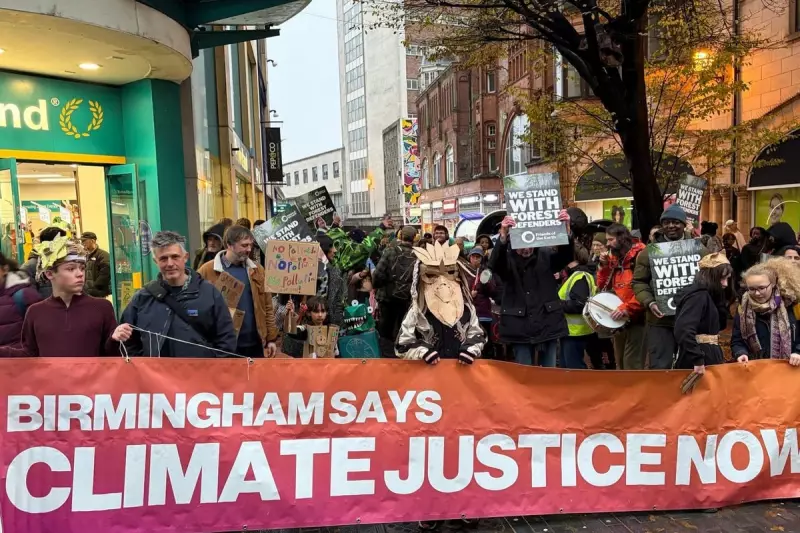
While world leaders convened at the COP30 climate summit in Brazil, the streets of Birmingham witnessed a powerful display of grassroots creativity and hope. On Saturday 15th November, a vibrant Cardboard Carnival parade, featuring brightly-painted model animals, marched through the city centre, offering a colourful counterpoint to often-gloomy environmental headlines.
A Carnival of Creativity and Conservation
The event brought together more than 200 participants who took part in art and music workshops at The Edge arts space in Digbeth before joining a lively procession to Birmingham Cathedral. The creative activities were spearheaded by young people from the co-operative movement Woodcraft Folk and from Friction Arts Club.
Among the striking creations was a five-foot long model of a Ladybird Spider, one of the UK's most endangered spider species. In reality, this arachnid is smaller than a fingernail. The giant version was crafted by 13-year-old Clayton Young and fellow Friction Arts Club member, Ruby, who selected the rare creature to symbolise the threats facing life on Earth.

Voices for a Just and Sustainable Future
The carnival was also a platform for powerful speeches. Headlining was youth climate justice activist Scarlett Westbrook, who jointly organised the 2019 Birmingham School Climate Strikes at just 15 and later co-founded the climate education campaign Teach the Future.
Addressing the crowd in Pigeon Park, Westbrook struck an optimistic chord. "People are getting things done. We're seeing more climate wins than ever," she declared. "Things are not as horrible as the headlines seem. It's only going to get better, because we're going to keep calling for it. We're not going to let politicians keep kicking the can down the road."
Joining via videolink from the COP30 summit in Brazil was Dr Leon Sealey-Huggins, a Senior Campaigner at War on Want and a University of Warwick academic. He spoke about nations trapped in perpetual debt cycles and emphasised that campaigning for climate action must go hand-in-hand with fighting inequality. He called for societies that are "fair and fun to live in" where "everyone has the resources to live a dignified and fulfilling life."
Grassroots Momentum and Educational Shifts
Following the conclusion of COP30, which ran a day over schedule, Dr Sealey-Huggins expressed that he was "immensely proud" of the agreement to establish the Belem Action Mechanism. He described this as a vital victory that links climate action with social justice, equity, and sustainable development, embedding the fight for a just transition within the UN framework.
The spirit of the carnival was echoed by local volunteers. Toqueer Quyyam, a Hockley resident with eight years of volunteering for climate groups, stated, "compassion and love mean everything. By caring, we become the very human beings that can create that better world."
Meanwhile, parallel educational efforts were underway. The charity InterClimate Network held model COP summits for secondary school students in Birmingham, Solihull, and Dudley. Owen Gardner, COO of EarthSense, who participated in a Birmingham schools model COP, praised the students, saying, "The students were outstanding... I came away energised by how focused they were." This aligns with a recent government announcement, following Professor Becky Francis’s review, to embed climate and sustainability education in the curriculum.
John Cooper from the Birmingham Climate Justice Coalition encapsulated the day's core message, asserting that a sustainable world is built on fairness and shared responsibility, not coercion or profit. "This is not idealism," he said, "this is a necessity."