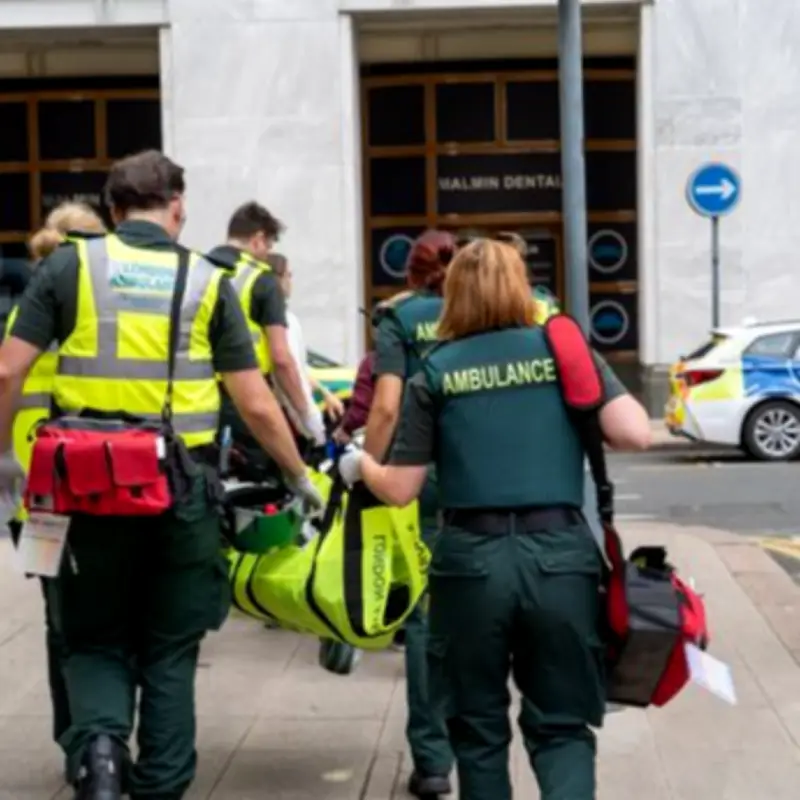
Emergency services in London have conducted a massive training exercise to test their response to a potential terror attack. The event, codenamed Firebird, took place at Canary Wharf on Sunday morning and involved approximately 1,000 participants, making it the largest of its kind in modern times.
This exercise comes shortly after the UK's terrorism threat level was raised to 'severe', indicating that an attack is highly likely. The scenario simulated a marauding terrorist attack, testing the skills of police officers, firefighters, paramedics, and counter-terrorism investigation teams. Actors were used to create realistic injuries and chaos, while Canary Wharf security staff also took part in the drill.
Poignant Reminder of Past Attacks
The exercise served as a stark reminder of the 1996 Docklands IRA bombing, which killed two people and injured over 100. Metropolitan Police Chief Superintendent Kris Wright, who directed the exercise, noted the significance of holding the drill at the same location. He said, 'It is quite poignant that Canary Wharf, the site of one of the most well-known terror attacks London has ever seen, is now hosting an exercise where we assure ourselves that as that threat has evolved, our response and our ability to combat that threat has evolved with it.'

Wright explained that the exercise incorporated lessons learned from real-life events, such as the Manchester Arena bombing. One key technique tested was '10-second triage', a method for quickly categorising and treating casualties with varying injuries during a catastrophic event. He emphasised that this approach was developed from the Manchester tragedy and is now being embedded across emergency services.
World-Leading Response
Chief Superintendent Wright praised the capabilities of London's emergency services, describing their response to catastrophic events as 'world-leading'. However, he stressed the importance of continuous training and vigilance. 'We shouldn't be complacent. We should continue to stretch ourselves and test ourselves, and that's what we do here today,' he said.
He also clarified that the exercise was not in response to any specific threat or intelligence. 'The terrorism threat level across the UK was recently raised to severe, so we always need people to be vigilant, but I hope this reassures Londoners that should the worst happen, we are ready and prepared to respond in the best possible way,' Wright added.
The exercise involved coordination between multiple agencies, including Counter Terrorism Policing London, the Metropolitan Police, London Fire Brigade, London Ambulance Service, and Canary Wharf Group. It aimed to test communication, decision-making, and joint operational procedures under pressure.