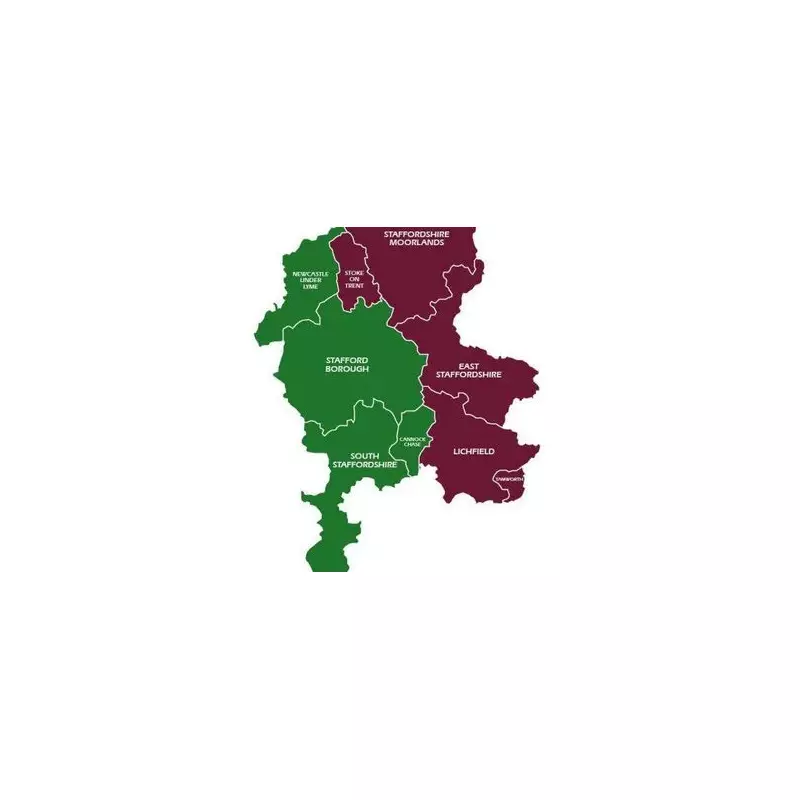
Staffordshire County Council has thrown its weight behind a controversial plan to divide the county into eastern and western unitary authorities, claiming this model represents the strongest option available for local government reorganisation.
Council Votes for Evidence-Based Approach
The Reform UK-controlled council saw its cabinet members formally back the authority's proposal, which would replace the current ten councils with just two unitary authorities spanning east and west Staffordshire. The vote represents a significant step in the ongoing local government reorganisation process driven by the Labour government.
Deputy council leader Martin Murray emphasised that the east-west option focuses on parity and equity for all residents. He stated: "We don't want either new council to be disproportionately burdened or disadvantaged because all of our residents, regardless of where they live, deserve quality, value for money services."

Geographical Logic Questioned by Opponents
The proposed model has faced criticism for what opponents describe as a lack of geographical coherence. The plan would combine Stoke-on-Trent with Lichfield and Tamworth in the eastern unitary authority while keeping it separate from neighbouring Newcastle-under-Lyme.
This approach contrasts with most other Staffordshire councils, which are backing alternative models featuring various forms of north-south division. Despite this opposition, county council leaders maintain their east-west alternative provides the strongest foundation for establishing two viable unitaries.
Business Case Supports East-West Division
The council's business case, prepared with assistance from consultants PwC, indicated that both east-west and north-south configurations would generate sufficient savings to recover transition costs within four years. Both models performed similarly against the government's six criteria for Local Government Reorganisation.
However, the business case suggested the east-west division would create two more balanced councils when considering economic factors, population size and social challenges. Councillor Chris Large, cabinet member for finance and resources, defended the council's modelling as "professional" and reliable, noting they had used the government's preferred consultants.
Councillor Murray condemned other councils for lobbying for or against particular configurations, maintaining Staffordshire County Council had adopted an impartial, evidence-based methodology. He stated: "It is not a pick-and-mix of who would like to be with who. It's about what is fair, equitable and gives the best chance of delivering our aspirations for Staffordshire's people."
Despite supporting their specific proposal, council leaders described the broader reorganisation as 'ill-advised' and 'rushed' by the Labour government. Councils across Staffordshire have until November 28 to submit their final proposals, with the ultimate decision resting with the government.