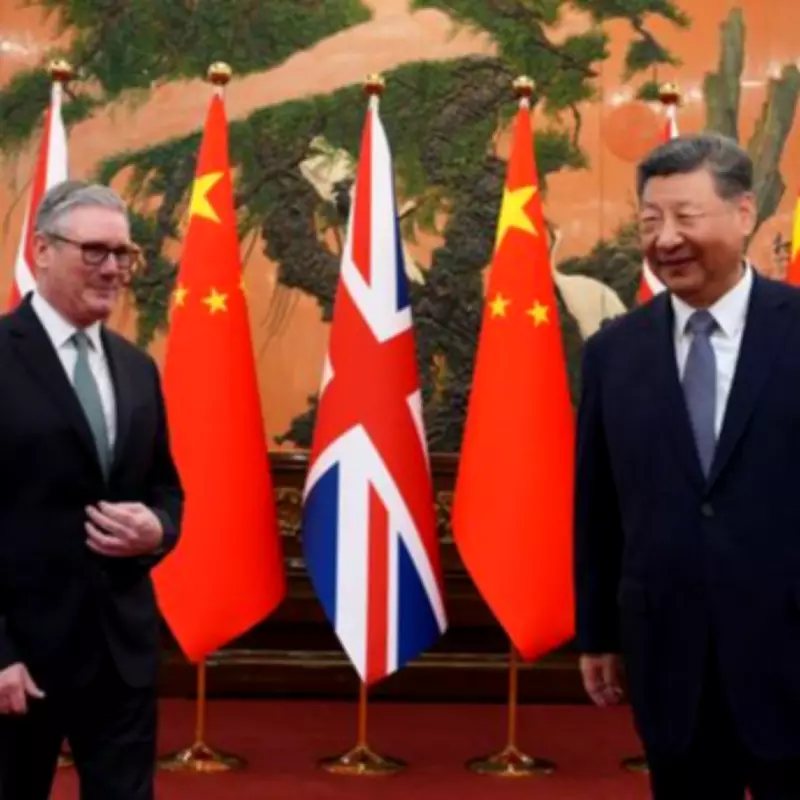
British Prime Minister Sir Keir Starmer has faced significant political criticism following his recent diplomatic mission to China, with opposition figures questioning the tangible outcomes of his engagement with the world's second largest economy.
Diplomatic Engagement Under Scrutiny
The Prime Minister's meeting with Chinese President Xi Jinping last week marked an attempt to reset bilateral relations between the United Kingdom and China. This significant diplomatic encounter represented the second meeting between the two leaders and constituted the first visit by a British Prime Minister to Chinese territory in eight years. Sir Starmer emphasised that Britain seeks a "more sophisticated" relationship with the Asian superpower, acknowledging China's substantial global economic influence.
Conservative Criticism of Approach
Conservative Party leader Kemi Badenoch delivered particularly pointed criticism in the House of Commons, characterising Sir Starmer's diplomatic strategy as adopting a "supine and short-termist approach" to engagement with China. While acknowledging that Britain should indeed engage with China as "a fact of life, a global power and an economic reality," Ms Badenoch suggested the Prime Minister returned with "next to nothing" beyond a Labubu doll souvenir.

"What we are criticising is his supine and short-termist approach," the Tory leader stated during parliamentary proceedings. "But apart from the Labubu doll in his suitcase – and I hope he's checked it for bugs – he has come back with next to nothing."
Liberal Democrat Perspective
Liberal Democrat leader Sir Ed Davey offered a more nuanced critique, acknowledging that Sir Starmer was correct to engage with China diplomatically but suggesting he did so "from a position of weakness." Sir Davey contrasted the Prime Minister's approach with what he characterised as more assertive diplomatic strategies, noting concerns about perceived imbalances in the negotiations.
"Unlike the Conservative Party, we think he was right to go and engage, but just like with President Trump, he approached President Xi from a position of weakness instead of a position of strength," Sir Davey commented, referencing previous diplomatic engagements.
Business Delegation Accompanied Visit
The Prime Minister's diplomatic mission included a substantial delegation of fifty-four representatives from British business and cultural institutions, indicating the government's intention to deepen economic and cultural ties with China. This collaborative approach aimed to foster stronger bilateral relationships across multiple sectors, though opposition critics have questioned the immediate practical outcomes of these efforts.
The political debate surrounding Sir Starmer's China visit reflects broader discussions about Britain's post-Brexit international positioning and how the nation should engage with global economic powers while maintaining its strategic interests and values on the world stage.