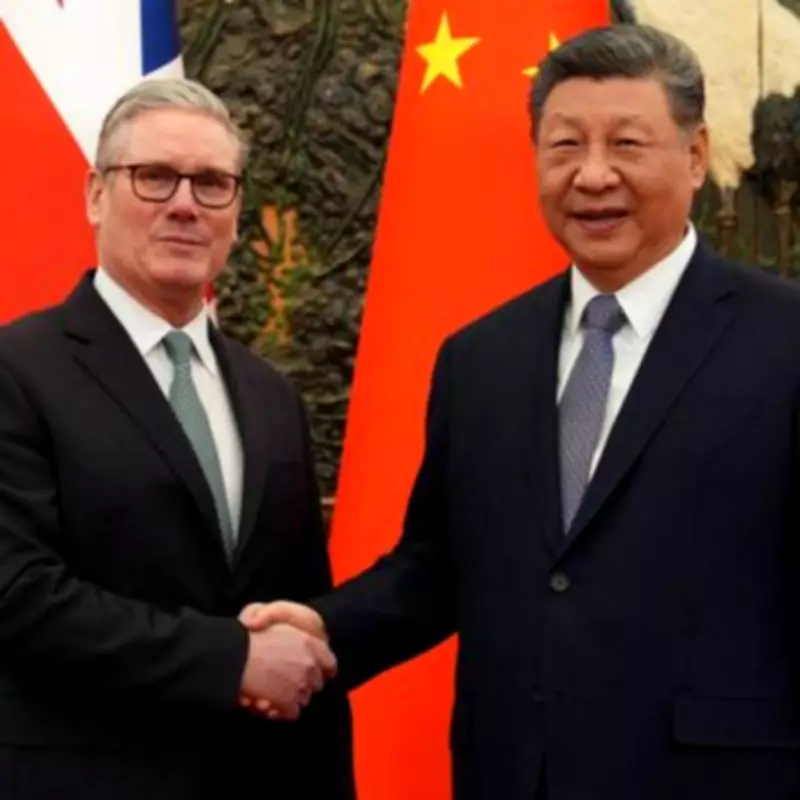
United States President Donald Trump has issued a direct and stark warning to the United Kingdom, labelling Prime Minister Sir Keir Starmer's efforts to bolster economic ties with China as a 'dangerous' course of action. This caution from the American leader comes as Sir Keir concludes a significant diplomatic visit to Beijing, marking the first trip by a British Prime Minister to China since 2018.
A High-Stakes Diplomatic Mission
Sir Keir Starmer's visit, aimed at forging a 'more sophisticated' relationship between the UK and the Asian superpower, culminated in high-level discussions with Chinese President Xi Jinping at the Great Hall of the People in Beijing. The Prime Minister's agenda focused squarely on enhancing economic cooperation and exploring new business opportunities with the world's second-largest economy.
Trump's Forceful Intervention
However, this diplomatic outreach has drawn sharp criticism from across the Atlantic. Speaking to reporters early on Friday, January 30th, President Trump did not mince words regarding the UK's strategy. 'Well, it's very dangerous for them to do that,' he stated, expressing clear concern over the UK engaging in deeper trade with the US's economic rival.

Trump expanded his warning, suggesting it was 'even more dangerous, I think, for Canada to get into business with China.' He emphatically added, 'You can't look at China as the answer,' casting doubt on the long-term viability of such partnerships. This commentary follows Canadian Prime Minister Mark Carney's own recent visit to China, where the two nations secured a preliminary agreement to lower tariffs on selected goods.
Tariff Threats and Trade Tensions
The US President's warnings were accompanied by tangible economic threats. Trump has explicitly threatened Canada with a 100% tariff on its exports should the country enter into a formal free trade agreement with China, a prospect Prime Minister Carney has since dismissed. In a related move, Trump also stated on his Truth Social platform that he would impose a 50% tariff on all aircraft sold to the US from Canada, citing a dispute over the certification of Gulfstream jets.
Starmer's Balancing Act
Amidst this transatlantic pressure, Sir Keir Starmer has maintained a firm stance on pursuing a balanced foreign policy. Ahead of his trip, he told Bloomberg that he rejects the notion of having to choose between Washington and Beijing. 'I'm often invited to simply choose between countries. I don't do that,' the Prime Minister asserted.
He emphasised the UK's enduring close relations with the United States, encompassing business, security, and defence, while simultaneously arguing for pragmatic engagement with China. 'Equally, just sticking your head in the sand and ignoring China when it's the second biggest economy in the world and there are business opportunities wouldn't be sensible,' Starmer reasoned, outlining a nuanced approach to international relations.
The Path Forward
As part of his visit, Sir Keir is scheduled to meet with business leaders in Beijing before travelling to Shanghai and then onwards to Tokyo for a working dinner with Japanese Prime Minister Sanae Takaichi. Furthermore, Downing Street has indicated it remains open to the possibility of a future state visit to the UK by President Xi Jinping, whose last such visit was in October 2015.
This development underscores the complex geopolitical landscape facing the UK, as it navigates its post-Brexit economic strategy between its traditional ally, the United States, and the rising global influence of China. President Trump's very public warning injects a significant new element of tension into these delicate diplomatic calculations.