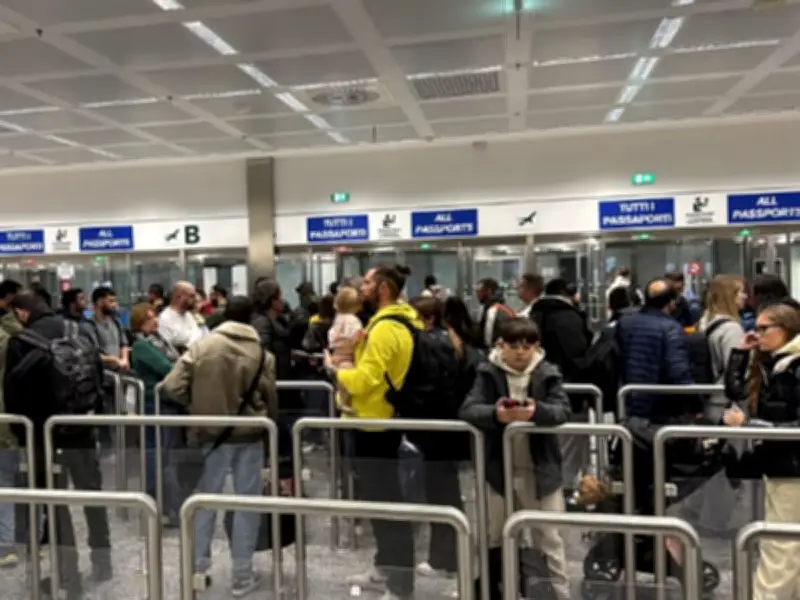
UK tourists in Italy could see new passport rules suspended to avert a summer 'disaster', as Rome's airports chief warns of severe congestion. Marco Troncone, CEO of Aeroporti di Roma which operates Fiumicino and Ciampino airports, told the Financial Times that exempting non-EU passengers from the new EU entry-exit system (EES) may be the only way to avoid peak season travel chaos. On a scale of one to 10, Troncone rated his concern as 'eight or nine', stating: 'The process proves to be incompatible with the peak volumes that we are going to face. So the only way is to open up the valve.'
Airport chiefs warn of six-hour queues
Troncone added: 'There is no way that we can deliver 100% of the enrolment.' The warning comes as the International Air Transport Association (Iata) reported that queueing times could reach six hours at some airports this summer, with waits of up to three-and-a-half hours already recorded during peak periods. Stefan Schulte, president of ACI Europe, a European airports trade body, told the BBC that individual EU governments, not airports, must decide whether to suspend the system. He urged politicians to 'stop pretending … that EES is working just fine. It is not.'
How the new EU entry-exit system works
Under EES, travellers must provide personal data at passport control, including a facial photograph and/or fingerprints, which are recorded in a digital file. Passports are no longer stamped. The process can be quicker if data is registered in advance. Holders of biometric passports can use self-service kiosks where available, and if no travel impediments are flagged, they may bypass a passport control officer entirely. However, Iata stated last week: 'Two months in, [the system] is producing long lines, missed flights, and growing alarm across the travel industry.'

Impact on UK tourists this summer
UK tourists, as non-EU nationals, are among those affected. Troncone's proposal to exempt non-EU passengers from EES would aim to reduce congestion at Italian airports during the busy summer season. The decision ultimately rests with EU member states, and no formal suspension has been announced. Schulte emphasised that airports alone cannot implement such changes, calling for political action to address the system's shortcomings.