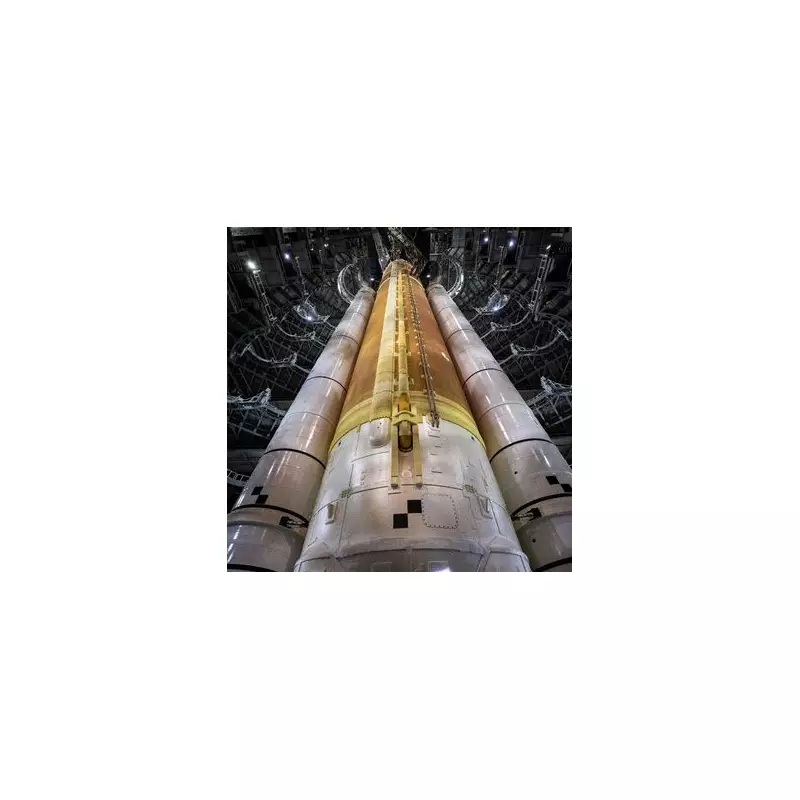
In a major milestone for human space exploration, NASA has begun moving the colossal rocket that will carry astronauts around the Moon for the first time in more than half a century.
The Journey to the Launchpad Begins
The Space Launch System (SLS) rocket and its Orion spacecraft started a slow, historic crawl to the launchpad at Florida's Kennedy Space Centre on Saturday. Mounted on the giant Crawler-Transporter 2 vehicle, the stack began its four-mile journey from the Vehicle Assembly Building, a trip expected to take up to 12 hours.
This move marks a critical step towards the Artemis II mission, whose launch window opens on 6 February 2026. The ten-day crewed flight will be the first to send humans around the Moon and back since the iconic Apollo 17 mission in 1972.

Preparing for a Lunar Proving Ground
Once at the pad, engineers will spend the coming days preparing the systems for a crucial rehearsal, which includes loading all the rocket's propellants. NASA Administrator Jared Isaacman stated the mission fulfills "a promise to the American people that we will return to the moon."
Speaking at a press conference, Isaacman highlighted the Moon's role as a "perfect proving ground" for future deep space technology. He envisions early lunar bases relying heavily on autonomous rovers for tasks like mining and mineral extraction, paving the way for more advanced AI capabilities in missions to destinations like Venus.
"Naturally, in terms of what we want to achieve in space, you're going to incorporate more autonomy in our robotic missions," Isaacman said. "But I tell you, if humans are on a spacecraft, they'll always have a vote."
The Crew and the Mission's Legacy
The Artemis II crew comprises NASA astronauts Reid Wiseman, Victor Glover, and Christina Koch, alongside Jeremy Hansen from the Canadian Space Agency. For Hansen, a former fighter pilot, the mission has changed his perspective. "I had previously taken the moon for granted," he admitted. "But now I've been staring at it a lot more."
Astronaut Christina Koch emphasised the scientific bounty the Moon represents, calling it a "witness plate" for Earth's erased history. Studying it could reveal secrets about solar system formation and the potential for life elsewhere.
The ambitious Artemis programme aims to establish a sustainable human presence on the Moon, serving as a stepping stone for the ultimate goal: crewed missions to Mars. Following Artemis II, the Artemis III mission is planned to return astronauts to the lunar surface.
The upcoming mission will conclude with the Orion capsule splashing down in the Pacific Ocean, where the crew and spacecraft will be recovered by the US Navy.