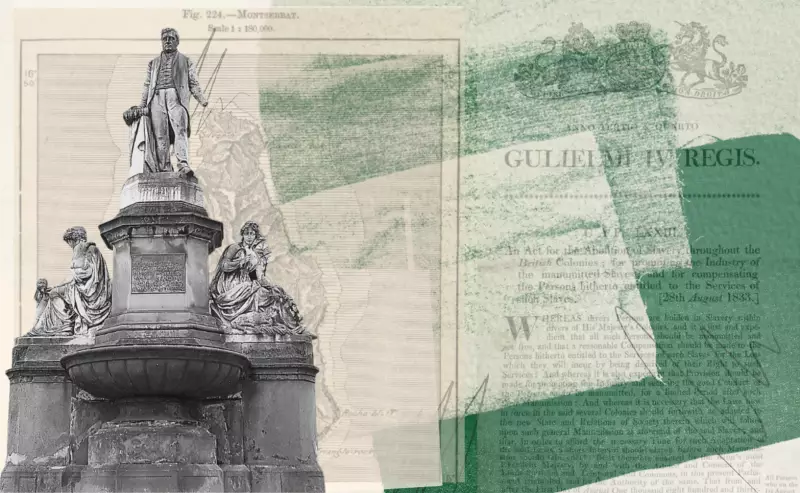
The marble statue standing in Birmingham's Five Ways roundabout represents more than just a historical figure - it commemorates Joseph Sturge, the city's radical Quaker abolitionist whose efforts brought about the real end of slavery in the British Empire.
The Overlooked Monument to Real Emancipation
Surrounded by 1960s tower blocks and constant traffic, the statue of Joseph Sturge often goes unnoticed in its sunken pedestrian space. Yet when it was unveiled in 1862, over 12,000 local residents gathered to witness the occasion. The figure depicts Sturge in Quaker dress, hand resting on a bible, with two female figures representing Peace and Charity beside him.
What makes this monument particularly significant is its connection to what Caribbean communities actually celebrate as emancipation day. While mainstream British history focuses on the Abolition Act of 1833, Sturge recognised this as inadequate, describing the subsequent 'apprenticeship system' that forced former slaves to continue working for their masters as "slavery in another name."

From Businessman to Full-Time Campaigner
Born to a middle-class Quaker family in Gloucestershire in 1793, Sturge moved to Birmingham during its rapid growth period. He and his brother established a successful corn trading business on Broad Street, using the canal network at Gas Street Basin for distribution.
His commercial success allowed him to transition to full-time activism, initially working with the Society for the Mitigation and Gradual Abolition of Slavery. However, he grew frustrated with their cautious approach and broke away to campaign for complete and immediate abolition.
The Fight for True Freedom
When Parliament passed legislation in 1832 that theoretically abolished slavery, Sturge was outraged by two key aspects. The government paid £20 million compensation to slave owners - equivalent to 40% of the entire national budget - while the enslaved received nothing.
More crucially, the act established an 'apprenticeship system' requiring former slaves to continue working for their masters for up to twelve years. Only children under six were immediately freed.
Sturge launched an intensive campaign through pamphlets, talks and marches, largely centred on Birmingham. His efforts culminated in the abolition of this apprenticeship system on 1st August 1838 - the date now celebrated as true emancipation in the Caribbean.
A plaque once laid at the Negro Emancipation School Rooms in Heneage Street, Aston commemorated this achievement, describing Sturge as "the friend of negro, the friend of children, and the friend of man."
Dr Nathaniel Adam Tobias Coleman, a Birmingham-born academic-activist, notes the irony that while Britain prominently displays statues of slave traders, monuments to anti-slavery activists like Sturge often remain overlooked. The 2007 restoration of Sturge's statue, Coleman points out, occurred on the 200th anniversary of the slave trade prohibition - an achievement Sturge himself would have considered insufficient.
Sturge's legacy presents a complex picture of radical commitment to abolition alongside paternalistic attitudes, but his crucial role in achieving genuine freedom for enslaved people establishes Birmingham's significant contribution to one of history's most important moral campaigns.