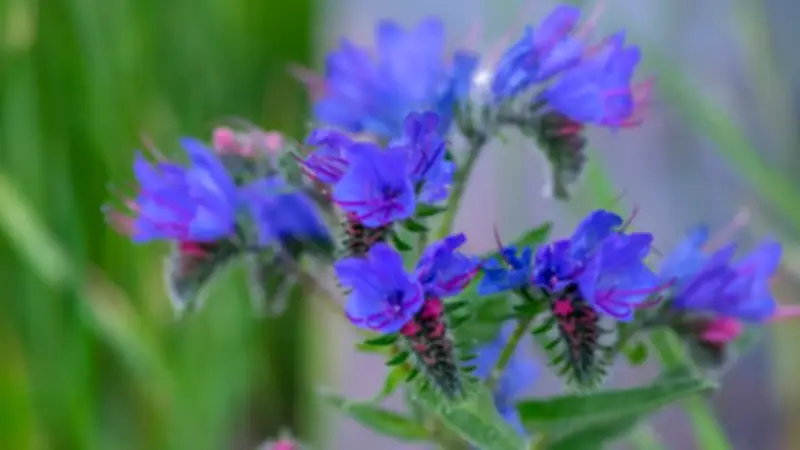
A year ago, a gardener made an impulsive purchase of a plant called viper's bugloss (Echium vulgare), solely because of its name. Native to the UK, this wildflower is rarely found at modern garden centres but was sourced from a local nursery specialising in native herbs and wildflowers. The nursery was discovered after a seemingly futile search for angelica, a statuesque plant that now attracts bees each spring.
The Growth and Bloom of Viper's Bugloss
Viper's bugloss is a biennial that forms a low-lying rosette in its first year, which might be mistaken for a weed. However, patience proved virtuous as the plant grew and became more ungainly, spreading out and competing for space. Winter caused it to die off, but the remnants were left in place. In the second year, the bugloss returned slowly, then produced over ten spires on each of the two plants. Three weeks ago, it dressed the metre-high spikes in striking blue flowers, attracting a multitude of pollinators including bumblebees, solitary bees, hoverflies, and hummingbird hawk-moths.
Challenges of Impulsive Consumerism in Gardening
The two plants sit at either end of a wildlife pond, competing with self-seeding fennel, foxgloves, and red valerian. This season will be their last; after flowering, they will set seed and die, leaving a two-year wait for the next explosion of colour. The gardener noted that planting a second set the following spring would have ensured annual colour, a lesson learned the hard way.

Other Biennial Plants for Pollinators
Viper's bugloss is not the only biennial that brings pollinators to the garden. Here are five others to consider:
Foxglove (Digitalis purpurea)
Foxgloves produce towering spikes of pinkish-purple, bell-shaped flowers with spotted throats. They are structurally engineered for long-tongued bumblebees, providing a landing pad and dusting the bee's back with pollen. Ideal for dappled shade and woodland borders, they tolerate poorer soils well. Warning: All parts are highly toxic if eaten.
Teasel (Dipsacus fullonum)
Teasel offers incredible architectural structure with large, prickly cones ringed with lavender-pink flowers, followed by sculptural seed heads. In summer, flowers attract bees and butterflies; in autumn and winter, seed heads become a crucial bird feeder for goldfinches. Even its leaves catch rainwater for insects. It belongs at the back of a border or in a wild corner.
Angelica (Angelica archangelica)
Introduced to the UK in the Early Modern Period, angelica produces enormous, spherical, lime-green umbels on thick stems up to eight feet tall. The massive flower heads feed hundreds of insects, attracting predatory hoverflies, ladybirds, and parasitic wasps that act as natural pest controllers. It thrives in damp, fertile soil and dappled shade.
Weld (Reseda luteola)
Also known as Dyer's Rocket, this historic British native produces slender spikes of yellowish-green flowers. It is a hit with smaller solitary bees and hoverflies and is the primary food plant for caterpillars of Large White and Small White butterflies. Perfect for sharp-draining spots, gravel gardens, or sunny, dry borders.
Tree-mallow (Lavatera arborea)
A fast-growing coastal native that develops into a woody shrub, producing clusters of soft, hibiscus-like flowers in lilac-pink with dark purple centres. The broad flowers are heavily laden with nectar and pollen, attracting bumblebees and honeybees. Its dense foliage provides shelter for insects. Ideal for coastal gardens or as a focal point in a sunny border.
Books for a Native Wildlife Garden
To transform a garden into a native wildlife haven, consider these five essential books: Flora Britannica by Richard Mabey explores cultural and botanical connections; The Observant Walker by John Wright breaks down British landscape by habitat; Starting Out with Native Plants by Charlotte de la Bédoyère explains advantages of British flora; Collins Wild Flower Guide by David Streeter is the gold standard for identification; and The Wild Flower Key by Francis Rose uses a system of keys based on leaves and structures.