This year's annual musical-theatre showcase from the Guildford School of Acting had a stunning effect. The Gala Night audience for agents, producers and theatre insiders broke into spontaneous applause on several occasions, acknowledging that this student production was somehow shifting from showcase to industry launchpad.
An industry launchpad
What unfolded on the stage of Guildford's Yvonne Arnaud Theatre was not merely evidence of accomplished training but a collective display of skills, confidence and theatrical instincts not usually seen in actors just out of training. The GSA's reputation for producing musical theatre performers who rapidly progress to the West End was not merely reinforced - it was vividly embodied.
Young Frankenstein production
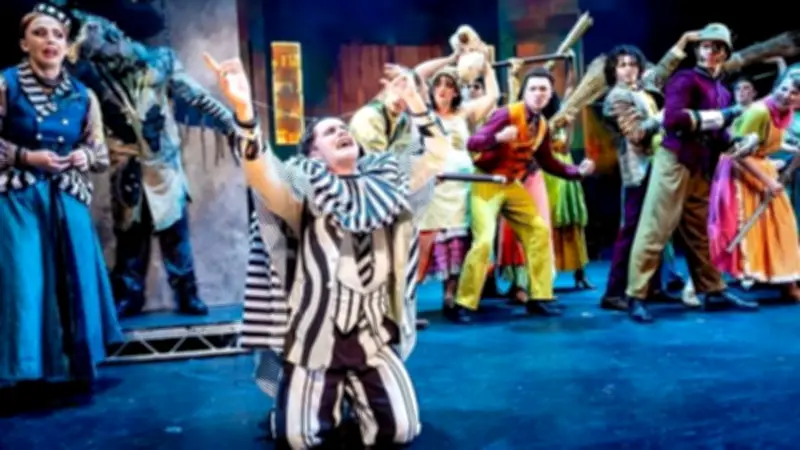
Directed by Will Holyhead, Young Frankenstein, the Mel Brooks musical, arrived with edge, energy, polish and unapologetic pizzazz. It's a stage adaptation from Brooks' earlier film, which in turn was inspired by Mary Shelley's Frankenstein mythology, and follows the reluctant Dr Frederick Frankenstein, grandson of the notorious Victor Frankenstein, as he attempts to distance himself from his family's dark scientific inheritance.

Drawn unwillingly back into a Gothic world of castles, eccentric assistants and dubious experimentation, he finds himself confronting both legacy and temptation in an increasingly comic and chaotic fashion. That journey is routinely surprising but on occasions brazenly lewd. However, it also embraces a knowingly playful attitude that carries the audience along with it.
Standout performances
The GSA cast was led by George Acworth, who delivered the iconic line "I am not Frankenstein, I am Fronk-en-steen!" with such conviction that he flourished at every turn. At times, this reviewer was reminded of the then-unknown Charlie Stemp in his Chichester press night debut of Half a Sixpence - the sense that a successful theatrical career may just be gathering momentum. Stemp went from Chichester to the West End, then to Broadway in Hello Dolly, his journey one of rise and rise.
Ashton Sharp as Igor, Fronk-en-steen's henchman, confounding anatomical expectation with the immortal "What hump?", proved an irresistible comic presence, extracting every ounce of humour in a well-judged supporting role. The humour of the evening came from the collapse of lofty scientific ambition into broad farce, with lines like 'Are you saying I put an abnormal brain into a seven and a half foot long, fifty-five inch wide gorilla?', 'Mmm, that door has big knockers!', 'Yes, he is scary but boy can he dance!', and one simple line that convulsed many around me: 'Could be worse, could be raining!'
What we had was a collision of Gothic melodrama, American vaudeville timing and gloriously anachronistic wise-cracks, then add in hi-energy song and dance routines plus characters drawn in deliberately outsized theatrical strokes. If only fairness ruled this review, every cast name would find a proper mention, but word-count and show-business, like criticism, has never quite worked that way. Suffice to say, this cast was uniformly seen to advantage, and I wish them all - on stage and backstage - the successes they have hitherto only dreamt about.
The production was, as usual, open to the public and many came along. But although the show has closed, new careers are beginning.
Remembering Patricia Grayburn
I have already acknowledged in this column the recent death of Patricia Grayburn MBE DL, who died at the age of 95, which belied her active support for local and national arts. She leaves behind something rarer than formal recognition: a genuinely multi-generational sense of regard. This was evident at her memorial service last week at St James's Church, Shere, where the breadth of ages attending spoke quietly but unmistakably to the reach of her engagement within the arts community.

I had drifted, accidentally, into arts commentary, briefly on television (which I never much enjoyed), then for many years on radio and later in print. Through it all, Pat's encouragement stood out for its consistency and quiet wisdom. She would offer praise and occasionally sharp criticism, but which was always rooted in engagement, support and reason. Following the memorial, the subsequent gathering at West Horsley Place, full to almost overflowing, was not merely an occasion for remembrance but a continuing acknowledgement of her influence on so much - and on so many.