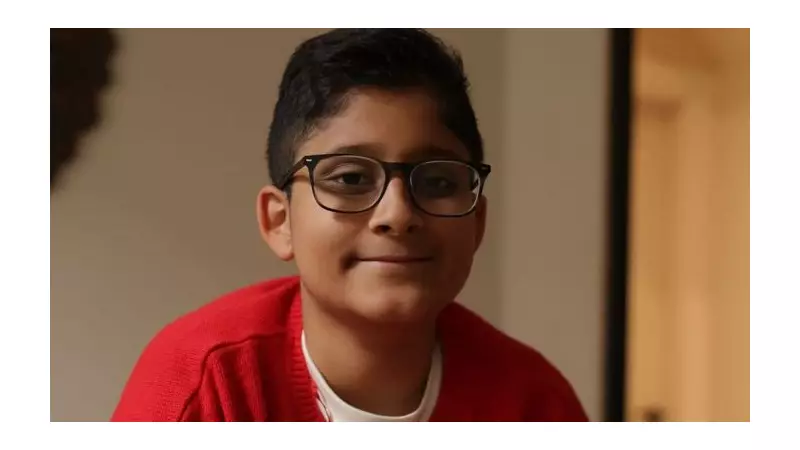
A 13-year-old boy from Pinner experiences the world without colour, viewing life exclusively in shades of grey due to a rare genetic eye condition. Avi Krishnan and his family are now championing a UK-wide charity appeal to raise awareness and fund critical research into sight loss.
Living in a Monochrome World
Avi lives with achromatopsia, an inherited condition diagnosed when he was just two and a half years old. This disorder, affecting roughly one in 30,000 people globally, impacts the retina's light-sensitive tissue. For Avi, it means bright lights are painful and he cannot perceive colours, even during the vibrant festive season. "I can't see any colour and in general I can't see as far away as other people can. And when it's very bright, it's a bit difficult to see," Avi explains.
His condition also includes nystagmus, which causes his eyes to wobble. This was among the first signs that alerted his parents, Janki and Anant, that something was amiss. Janki, who holds a genetics degree, recalls early developmental concerns. "Before he was one, we noticed that he wasn't pointing, nor making the appropriate sounds in terms of talking as well. Developmentally, we felt that there was something not quite right," she says.

Despite initial dismissal by a health visitor, the family persisted. Avi was referred to Great Ormond Street Hospital, where tests confirmed he had inherited two faulty genes causing achromatopsia. "We were told that he would only see in shades of grey. It came as quite a shock," Janki admits, remembering the devastating warning that Avi would likely never drive.
Pioneering Treatment and Family Resilience
In 2020, Avi participated in a groundbreaking gene therapy trial at Moorfields Eye Hospital, becoming one of only nine UK children to do so. He missed his school Christmas celebrations for the pioneering treatment, which aims to deliver a correct copy of the faulty gene into the eye's cone cells.
The trial has yielded marginal improvements in his left eye, including slightly better perception, reduced nystagmus, and less light sensitivity. "Research takes time. It takes a lot of time and money and may not work perfectly or at all, but we just felt that we couldn't miss that opportunity to try," Janki states, highlighting the family's hope in sight loss research.
The condition affects daily family life in poignant ways. Janki notes her instinct to point out rainbows to Avi and his younger brother Aarav, before catching herself. "Obviously, Avi can't see the colours, and I’m not sure if he sees the rainbow at all," she shares.
Raising Funds and Awareness for a Cure
The Krishnan family is deeply committed to supporting the charity Fight for Sight. Last year, Avi, Aarav, and their father Anant swam 8km over 30 days, raising £2,500. Both boys have also spoken about sight loss at their schools, an effort that has already made an impact. Anant reveals, "After Aarav’s speech, an older pupil told him he also had nystagmus. This is why it’s important to share stories; to reach people."
Despite the challenges, Avi is determined to contribute. "I’m at the stage where I can give back. Fight for Sight is a wonderful charity with a mission to stop sight loss through pioneering research, and we need funding to get there," he asserts. He still looks forward to Christmas, appreciating it through other senses. "It has a certain smell. I’m excited because I wonder what gifts we are going to get," he adds.
Aarav, Avi's biggest supporter, speaks with immense pride. "The world isn’t built for people like my brother, even though he’s brilliant. Avi is funny, kind, incredibly clever and my best friend. I’m very proud of him and lucky to have him as my big brother."
Keith Valentine, CEO of Fight for Sight, praised the family's efforts. "We are so grateful to Avi and his family for sharing their story and for their fantastic awareness raising and fundraising efforts. Sight loss research has come on in leaps and bounds in recent years, and we are confident that the development of AI will quicken its pace considerably."
He added an optimistic yet urgent note for the charity's Christmas appeal: "There is a lot to be optimistic about this Christmas when it comes to sight loss research, but more funding is desperately needed to speed up the process."