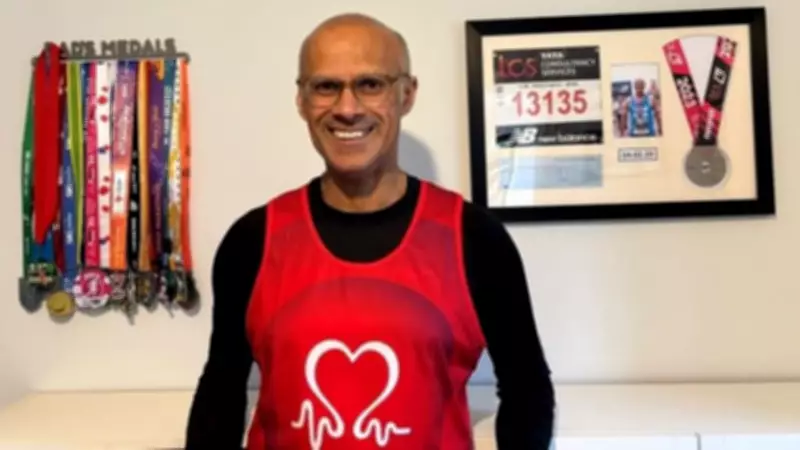
Lincoln Man to Run Manchester Marathon After Surviving Cardiac Arrest
Bupendra Parmar, a 61-year-old resident of Lincoln, is set to take on the Manchester Marathon next month, marking an extraordinary milestone in his recovery from a cardiac arrest that nearly claimed his life less than two years ago. He is raising vital funds for the British Heart Foundation (BHF) and using his story to promote awareness of CPR and defibrillator use.
A Sudden Collapse and Swift Response
In May 2024, Bupendra collapsed without warning while working from home. Moments earlier, he had mentioned feeling "a bit tight-chested" during a work call before heading outside to meet sales representative Nick Tooby, who was delivering a car for a test drive. As Bupendra sat in the driver's seat, he suddenly lost consciousness.
Nick immediately realized something was seriously wrong and alerted Bupendra's wife, Suzanne, who dialled 999. Under the call handler's guidance, she began CPR, with Nick stepping in to continue chest compressions. Within minutes, a paramedic arrived and delivered two shocks with a defibrillator before more ambulance crews and the local LIVES car attended. Bupendra was stabilised and taken to Lincoln County Hospital, where a fully blocked left artery was treated with a stent.

From Recovery to Marathon Training
A father of two and a keen runner since 2012, Bupendra has completed numerous long-distance events, including the Yorkshire Marathon and the 2023 London Marathon. He had been planning to run the Manchester Marathon in 2025 but had to postpone following his cardiac arrest. After gradually rebuilding his fitness through walking, Parkrun, and steady training runs, he has now been given the go-ahead by his cardiology team to tackle another 26-mile challenge.
Bupendra reflected on his journey: "In many ways, what happened to me was incredibly unlucky. I look after myself—I'm relatively fit, I don't smoke, I don't drink excessively—so I thought I was doing all the right things. But at the same time, I'm incredibly fortunate. Everything lined up perfectly that morning: Suzanne was home, Nick was there, the paramedic arrived within five minutes, and the hospital is nearby. I'm only here because CPR was started straight away."
A New Perspective on Running and Health
Bupendra's experience has reshaped his approach to fitness and health. He shared: "Coming back to running has been a real journey. I've had to learn to listen to my body in a way I never did before. When I start, I go slowly, warm up properly, and take breaks if something doesn't feel right. To line up at the start of the Manchester Marathon will feel huge. I know I'm not going to get a sub-four-hour time anymore, but if I can finish in under five hours, I'll be happy. Just getting to the finish line will mean everything."
Raising Funds and Awareness for Heart Health
His cardiac arrest has also fuelled a determination to support heart research and encourage CPR training. Bupendra continued: "I'm running for the BHF because research saves lives. The treatment I received, the speed of the diagnosis, and the equipment the paramedics used only exists because of research. I also want to encourage people to learn CPR. Defibrillators are vital, but without someone pushing on your chest in those first few minutes, you don't get that second chance. I'm only here because people stepped in and weren't afraid to act."
In the UK, there are around 40,000 out-of-hospital cardiac arrests (OHCA) each year, with the survival rate estimated at less than one in ten. Ella Hall, senior events executive at the BHF, commented: "Bupendra's story is extraordinary. Surviving a cardiac arrest is rare in itself, but to return to marathon running less than two years later is truly inspiring. We're incredibly grateful that he's chosen to support the BHF, and his determination is a powerful reminder of why our research matters so much."
Bupendra's fundraising efforts highlight the importance of community support and medical advancements in saving lives. His journey from a near-fatal event to marathon readiness serves as a testament to resilience and the critical role of immediate emergency response.