Recently examined historical plans have shed new light on how close Kent came to becoming the frontline of a Nazi invasion in the summer of 1940. Codenamed Operation Sealion, the German plan for invading Britain pinpointed Lympne Airfield as the heart of its initial assault, a fate narrowly avoided due to critical flaws in the German war machine.
The Airborne Assault Plan for Kent
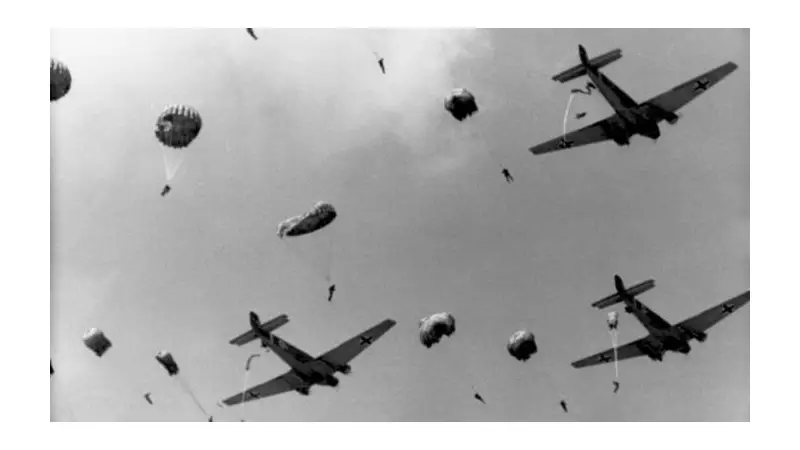
Had the invasion been launched, the first waves of the Fallschirmjager – the Luftwaffe's elite paratroopers – would have descended on Kent. Their mission was to execute two mass airborne landings at Hythe and Hawkinge. From these beachheads, their primary objective was the swift capture of Lympne Airfield.
Simultaneously, other paratrooper units were scheduled to drop around Paddlesworth and Etchinghill, before linking up with fellow battalions at Sandgate. A later wave would then land at Sellindge and Postling to surround the airfield and launch a coordinated ground attack. The plan also included a glider-borne assault using the DFS 230, a glider capable of carrying nine troops.

Once the airfield was secured, the strategy called for the 22nd Airlanding Division to be flown in to reinforce the perimeter. The occupying force would then advance to hold the line of the Royal Military Canal through Romney Marsh. The Luftwaffe intended to follow up by basing Messerschmitt Bf 109 fighter aircraft at the captured airfield, establishing immediate local air superiority.
Logistical Failures That Doomed the Invasion
Despite the detailed planning, Operation Sealion was crippled by severe logistical shortcomings. A critical shortage of Junkers Ju 52 transport aircraft was a major factor. Many of these planes had been lost or damaged beyond repair during earlier campaigns in Norway and the Netherlands.
This shortage had cascading effects. The limited heavy-lift capacity meant that paratroopers could not be accompanied by essential support equipment. No anti-tank guns, armour, transport vehicles, or even light armoured cars could be included in the aerial assault, leaving the elite troops dangerously exposed.
The problems ran deeper than just aircraft. Gliders were in desperately short supply, and there was even a lack of parachute silk. German officials were forced to scour occupied France for suitable silk or alternative materials. Furthermore, a lack of jump training for new recruits hampered the readiness of the airborne forces.
Why the German War Machine Was Not Invincible
The planned invasion barges, assembled in French ports, were another example of compromised design, far inferior to the landing craft the Allies would use in Normandy four years later. Historians note that the German military, often perceived as invincible in 1940, was primarily geared for Blitzkrieg – lightning war with minimal support. It relied heavily on captured equipment, vehicles, and even manpower. Unlike the fully mechanised British forces, the Nazi war machine was still dependent on horses for much of its transport.
The culmination of these weaknesses, combined with the determined resistance of the Royal Air Force during the Battle of Britain, convinced Hitler to abandon the plan. After the pivotal air battles of September 15, 1940, Hitler was persuaded an invasion was impossible. He gave orders just two days later, on September 17, for Operation Sealion to be indefinitely and inconspicuously postponed.
The Lympne Airfield History Society continues to explore this pivotal history. Their next meeting, entitled "Lympne – One Day in the Battle of Britain", will be held on March 3. The talk by Rob Beale will provide a minute-by-minute account of a day when the airfield was attacked by Göring's Luftwaffe. Meetings are held in Lympne church, with doors opening at 6.30pm and a £3 entry fee.