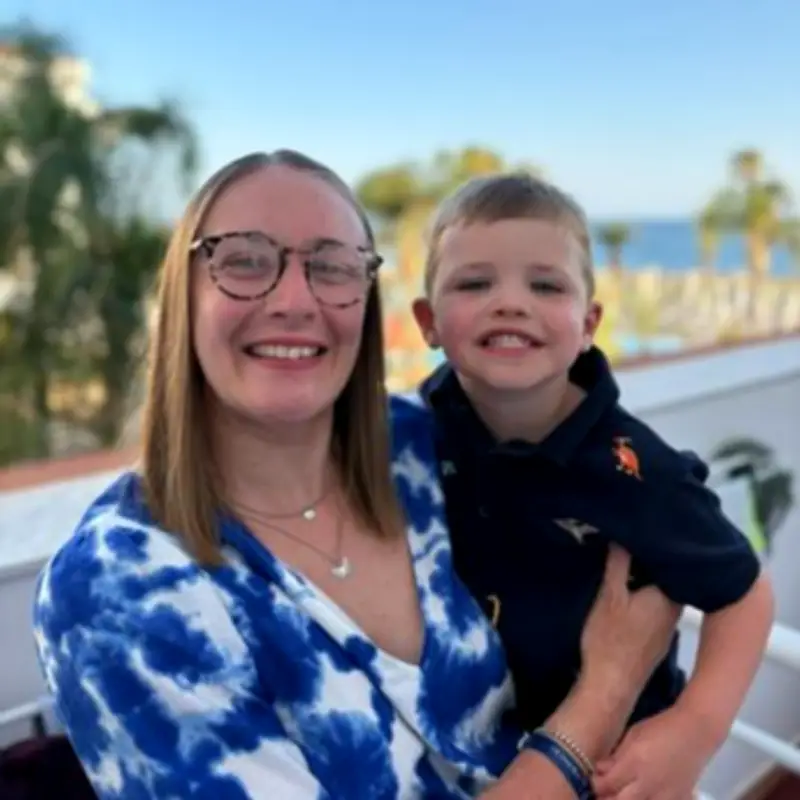
A mother whose skin tears and blisters from everyday activities like writing, walking, and eating was 'devastated' to discover her young son had inherited the same rare condition. Jennifer Taylor, 34, from Prescot, Merseyside, who is under the care of Solihull Hospital, first noticed the signs when her son William was just ten days old. While bathing him, the skin on his leg 'peeled off' the day before his newborn photoshoot.
The Condition: Dystrophic Epidermolysis Bullosa (DEB)
Jennifer first displayed symptoms of dystrophic epidermolysis bullosa (DEB) as an infant when her thumb blistered, turned purple, and her fingernail fell off. This genetic condition, often called 'butterfly skin' because it leaves skin as delicate as a butterfly's wings, affects at least 5,000 people in the UK. During her childhood, Jennifer's feet blistered from walking, forcing her to wear slippers to school. She also experienced blistering and a 'web' of scar tissue in her oesophagus. As a teenager, she endured bullying and low self-esteem, unable to wear makeup or style her hair and nails due to the irritation they caused.
William's Diagnosis
In 2021, after William's birth, Jennifer learned he had inherited DEB when a bath caused his leg skin to tear. Simply cradling William caused Jennifer's skin to itch and blister, while he displayed identical symptoms, including mouth blisters from chewing. Jennifer, married to Matthew, 34, said: 'We wish even doctors knew more about it – they often don't give us enough dressings, they don't realise how much we need. We have to change our dressings multiple times a day, constantly – I change William's ten times a day sometimes. Even cooking, I might burn myself or some steam gets on me, and that'll make my skin blister and I'll be in pain for weeks – it's the same with housework.'

Family History and Early Signs
Jennifer's father also suffered from the condition, so her family spotted warning signs early, though she wasn't officially diagnosed until several years later. She recalled: 'I'd get blisters on my feet just from walking to school, so I often wore slippers or trainers. The skin on my hands would get sore and bleed and blister from writing – someone else had to write for me. I got bullied a lot but I had a small group of friends. On sports day I had to sit to one side, and I watched everyone else play – if I went outside I'd hurt myself.'
Medical Journey and Support
Jennifer received a formal diagnosis at Great Ormond Street Hospital aged nine. At 13, she underwent oesophageal dilatation after blistering in her oesophagus. She grew increasingly self-conscious, losing fingernails and unable to style her hair due to her delicate scalp. Wearing makeup left her skin red, blotchy, and dry, while perfume triggered flare-ups. She often stayed home due to pain, feeling 'really alone, like I was the only teenager going through it.'
At 16, she met her now-husband Matthew, who researched the condition and has been her 'rock' ever since. At 30, in 2021, after another oesophageal dilatation, Jennifer became pregnant. She experienced intense itching, which caused substantial blistering from scratching. She had a caesarean section to 'minimise trauma' to herself and her baby. After William's birth, he had minor marks, but she presumed it was normal newborn skin until the bath incident.
Daily Challenges and Adaptations
Jennifer treated William's skin with dressings and contacted Solihull Hospital, which connected her with Birmingham Children's Hospital. In mid-November 2021, William was formally diagnosed. 'It felt awful to know he had it because of me, I was devastated,' she said. During his early months, Jennifer adapted to handling both conditions. She breastfed for six weeks with shields and creams. 'Even the heat from holding William would make my skin itch,' she added. As William grew, he developed blistering inside his mouth from chewing and teething.

In January 2024, Jennifer was diagnosed with a benign but aggressive 'giant cell' tumour in her foot and heel. She undergoes chemotherapy medication to slow growth and often uses a wheelchair. When William started nursery in September 2024, DEBRA, a national charity for epidermolysis bullosa, briefed staff on his condition. Jennifer said William 'understands' his condition and tells others he can get hurt easily, but he remains a 'typical four-year-old,' running around 'all day.' He uses a wheelchair with Spider-Man wheels, funded by DEBRA and Whizz Kidz, for family outings. 'It's hard because we don't always look like there's anything wrong – people don't realise what it's like day-to-day, the pain, the dressing changes, it's really tough!'
For further information and support, visit: www.debra.org.uk.