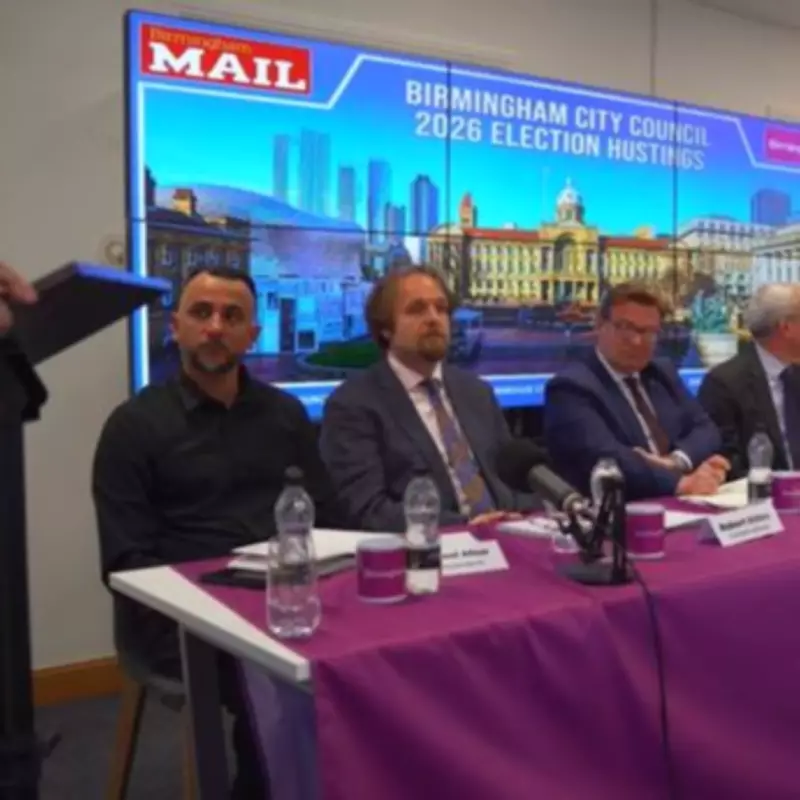
Any hope held by road safety activists that the next leaders of Birmingham City Council would commit to reducing the speed limit on all residential roads to 20mph have been all but dashed in a split second. A quickfire question posed to panelists at the BirminghamLive local elections hustings revealed that none of the rivals vying for votes intended to work towards a blanket 20mph speed limit on residential roads, except the Greens.
Their local leader, Julien Pritchard, was the only one to commit to getting the council to work towards introducing the new limit on roads where people live and close to schools, shops, and community facilities. Labour's John Cotton, who has positioned his party over the last four years as a champion of road safety, did not raise his hand. Nor did the Liberal Democrats, Reform, the Conservatives, or either of the city's Independent representatives, Shakeel Afsar (Independent Candidate Alliance) and Nosheen Khalid (Alum Rock Independent).
An image showing six of the seven panelists with their hands down, and only Pritchard with his hand up, quickly circulated among road safety champions and was decried by some as a 'sad reflection' on the extent of the commitment politicians were prepared to make to protect pedestrians and other vulnerable road users.

The person posing the question was Babiker Yahia, a mourning father whose daughter Mayar was killed by a reckless driver who was exceeding the speed limit on a 'short cut' road. His daughter died on a 20mph road where the speed limit was rarely enforced. He later said he was disappointed at the response.
Activist John Munro went further. On LinkedIn he wrote: 'This should be the defining image of the city council elections in Birmingham.' He added: 'Here is every candidate except Julien Pritchard of the Green Party saying directly to the father of a child killed by a driver that they wouldn't support even moderate measures to prevent this from happening to another family.'
The inner city council area is currently dogged by congestion, with many routes logjammed at critical points in the day. In some residential streets, the roads are lined with parked cars, often on both sides, posing an additional hazard. As a result, routes are often down to 20mph by default. But other residential two-way streets are plagued with speeding and dangerous driving, with campaigners pointing to roads used as short-cuts by motorists in a hurry.
Under the Labour administration, the city has introduced a range of road safety measures. They include implementing a Road Harm Reduction Strategy aiming to cut road deaths by 65% by 2035, declaring a 'road safety emergency', maintaining 30mph speed limits on most roads, increasing traffic calming, introducing 20mph zones in some 'school streets' near schools, and introducing low traffic neighbourhoods in Lozells and Kings Heath.
Better Streets for Birmingham and other road campaigners want the council to continue rolling out 20mph across the city. They say doing so has been shown to reduce casualties by 25% through signage, focusing on residential streets and local centres. They believe it can be done through a rolling programme, area by area, and by making changes on residential streets that make them 'greener and calmer' so 20mph limits become self-enforcing. Doing so would lead to fewer collisions, a reduction in casualties, and reduced costs from dealing with incidents of harm.
The Conservatives have unveiled a manifesto for Birmingham that includes diverting millions of highways cash to fix potholes alongside an eye-catching plan to explore creating an 'underground' system for the city. Nationwide 20mph limits were introduced across Wales in 2023. Since then, data indicates that the 20mph default speed limit has significantly reduced road casualties, with around 100 fewer people killed or seriously injured in the first year. Collisions fell by 26% and overall casualties on 20mph/30mph roads dropped by around 25% - the equivalent of over 800 fewer injuries - in the 18 months from September 2023 to early 2025. By July 2025, average speeds were down by nearly 4mph, with 97% of vehicles monitored keeping under the enforcement threshold of 26mph. However, despite the safety figures, the policy faced a massive public petition to be scrapped, leading to a review and some Welsh councils reverting specific roads back to 30mph.