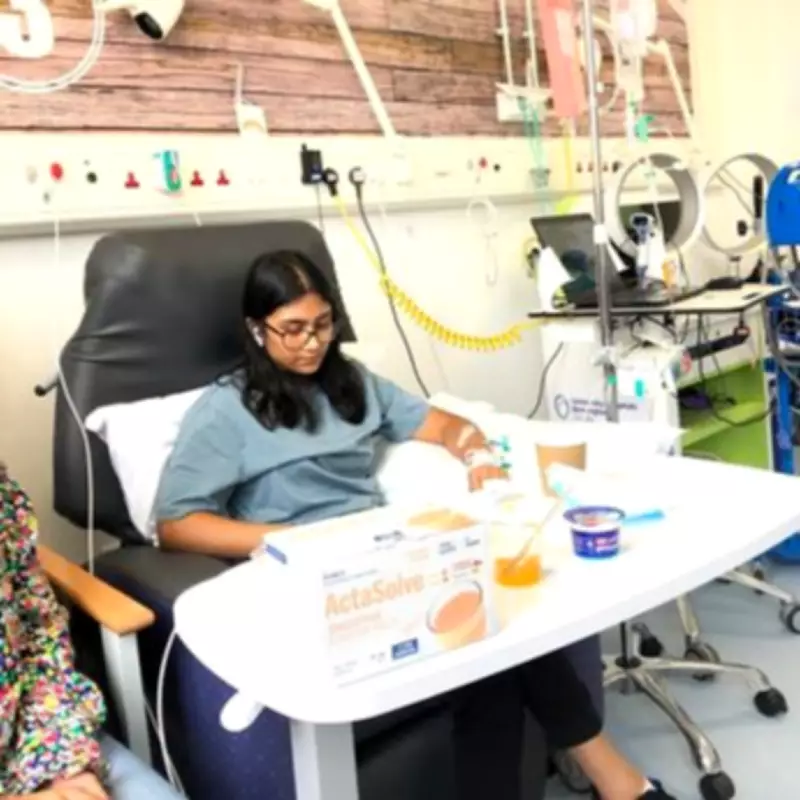
Tashifa Islam, now 20, has spoken out about the communication issues she faced during her treatment for a rare cancer, including doctors addressing her parents rather than her. Diagnosed with stage 3 nasopharyngeal carcinoma—a cancer in her throat behind her nose—just after taking her GCSEs in the summer of 2021, she experienced flu-like symptoms that she initially dismissed as hay fever or a seasonal cold.
In February 2022, she found a lump on her neck and visited her GP. An Ear, Nose, and Throat (ENT) referral was scheduled for three months later, but her mother insisted on going to A&E that same night. After being prescribed antibiotics and told the lump was likely a fluid sack, Tashifa underwent an ultrasound and biopsy, where her communication troubles began.
Speaking about her experience, Tashifa said: 'I could tell from the person doing the ultrasound's face that it was bad. At the start, he was easy-going and friendly, but he froze when he went over the lump. I felt like I had confirmation at that point that it would be something bad.'

A couple of days later, she was told she had stage 3 nasopharyngeal cancer. 'The doctor didn't have a 'poker face' when I was diagnosed. The cancer was rare so he seemed excited, but there needs to be more sensitivity. His tone was light-hearted, and I understand he was probably trying to make a serious situation more bearable, but I didn't really appreciate it.'
Now a Medical Science student, Tashifa understands the enthusiasm but emphasizes that at that moment, she wanted reassurance. 'You just want to know that it is manageable and treatable. When I heard things like 'rare' or 'unique,' it made me think they hadn't had much experience dealing with it, so it worried me more.'
Throughout her treatment, she found that doctors often addressed her parents more than her. 'I found that when doctors spoke, they would look more at my parents than me. And I'd just be sat there trying to catch their eye like 'I'm the one that's sick here, talk to me.' It felt a bit demeaning because perhaps they assumed I wouldn't understand due to my age, but they could just ask. I was more than capable of understanding, especially since I was taking biology.'
She also faced challenges outside the hospital setting. 'A part of my cancer experience that made me feel different was the cultural and religious aspect. I'm Bangladeshi and Muslim. Chronic illnesses are sometimes a bit taboo. People told me it was for the best and I'd be a stronger soldier, which was difficult to hear when fighting for my life. Some even blamed me for getting sick, because cancer is rare at a young age.'
Support from the Teenage Cancer Trust made a significant difference. 'Jade, a Clinical Nurse Specialist, was always available and supported me, especially when I wanted to ask about my treatment without my parents there. Without Teenage Cancer Trust, my experience would have been so much worse.'
Tashifa underwent chemotherapy and proton beam therapy and was told she was in remission in December 2022. She now studies Medical Science at De Montfort University in Leicester. 'Healthcare professionals should tailor their communication style based on the individual. Whether they want straightforward scientific information or simple explanations, getting a consensus on how they want to be spoken to would make communication better.'
Dr Louise Soanes, Chief Nurse at Teenage Cancer Trust, said: 'The way we talk about and explain cancer is so important, but it's a difficult subject. However, one conversation can change everything for a young person. The right words at the right time can make all the difference.'